IdeaPsychologyAlso in Philosophy
Mirror stage
Lacan's claim that the infant first gains a sense of self by identifying with its own image, so the self is founded on a mistake.
The idea
Between about six and eighteen months, a baby held up to a mirror does something that fascinated Jacques Lacan. It stares, laughs and leans towards the reflection with obvious delight. Lacan asked why. A baby of that age can't walk or feed itself, and it feels its body as a jumble of urges and limbs it barely controls. The mirror shows something else: a single, whole figure with a clear outline.
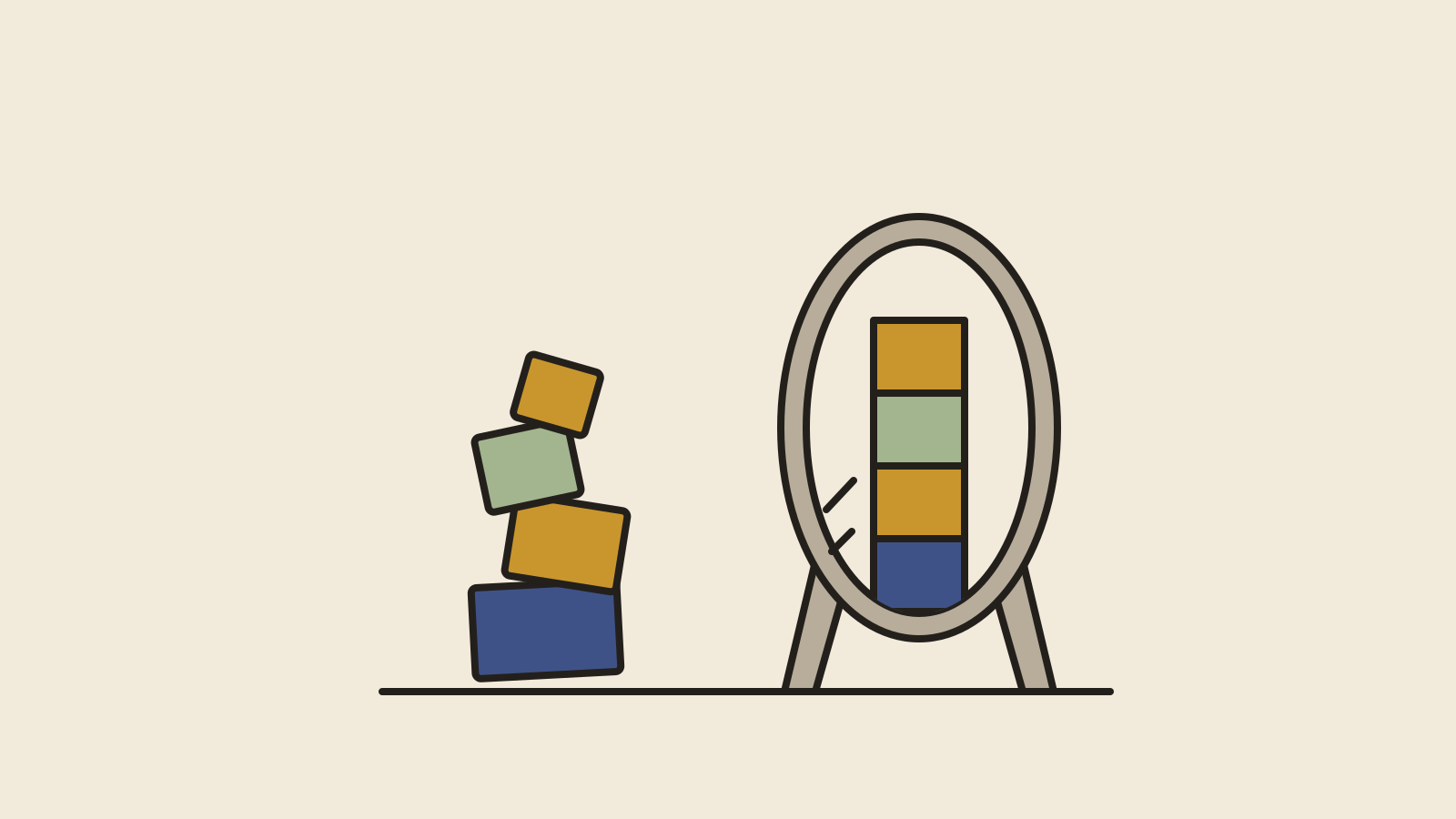
Lacan's claim is that the child takes this image to be itself, and that the ego begins here. The self is first met outside as a picture, and the picture looks more complete and more in command than the child feels. So the ego is built on a misrecognition, and it stays that way.
Adults repeat the move. Someone scrolling through their own carefully chosen profile photographs is looking at a self that is steadier and more finished than the person holding the phone.
Diagram
The ego forms when an uncoordinated infant identifies with a whole image
Read as text
Two factors meet to produce one outcome. The first is the infant's felt body, which has poor motor control and depends on carers. The second is the mirror image, which shows one whole outline and seems in command of itself. The infant identifies with the image, and the outcome is the ego. Because the image is more complete than the body the child feels, Lacan calls this identification a misrecognition.
Key features
- The image need not be in glass: another child of the same age, or a parent's answering face, can serve as the mirror.
- The ego is "imaginary" in Lacan's sense of being made from images, and it is where a person is most deceived about themselves.
- The gap between the smooth image and the felt body never closes, which leaves a lasting mix of self-love and rivalry with one's own ideal.
- The adult holding the child matters, because the baby turns to them to have the image confirmed.
- Lacan came to treat it less as a dated phase of infancy and more as a permanent structure of human experience.
Not to be confused with
| Look-alike | The difference | Differs on |
|---|---|---|
| Looking-glass self | Cooley's mirror is a figure of speech: the self grows from the judgements we imagine others make of us. Lacan's starts with a visual image of the body, and he stresses that the image deceives. | Differs onMechanism |
| Id, ego and superego | Freud's ego is the mind's realist, formed by contact with the world and charged with managing it. Lacan's ego is a flattering picture, formed by identification and prone to error. | Differs onClaim |
| Mirror self-recognition test | Psychologists dab a mark on a toddler's face and see whether the child touches it on seeing the mirror. Most pass late in the second year. Gordon Gallup found in 1970 that chimpanzees pass too, which undercuts the contrast Lacan drew with them. The test measures a skill. Lacan's claim concerns what the image does to the self. | Differs onMethod |
- Differs onMechanism
Cooley's mirror is a figure of speech: the self grows from the judgements we imagine others make of us. Lacan's starts with a visual image of the body, and he stresses that the image deceives.
- Differs onClaim
Freud's ego is the mind's realist, formed by contact with the world and charged with managing it. Lacan's ego is a flattering picture, formed by identification and prone to error.
- Differs onMethod
Mirror self-recognition test
Psychologists dab a mark on a toddler's face and see whether the child touches it on seeing the mirror. Most pass late in the second year. Gordon Gallup found in 1970 that chimpanzees pass too, which undercuts the contrast Lacan drew with them. The test measures a skill. Lacan's claim concerns what the image does to the self.
Origins and development
Lacan first presented the idea at a psychoanalytic congress in Marienbad in August 1936. Ernest Jones, in the chair, cut him off after ten minutes, and that paper was never published. The version read today dates from a congress in Zurich in 1949. Lacan drew on the psychologist Henri Wallon, who had described the child's mirror behaviour in 1931. He contrasted the child with the chimpanzee, which he said soon loses interest in a reflection. He also used Alexandre Kojève's reading of Hegel on recognition. From the 1950s he folded the idea into his wider account of the imaginary.
G. W. F. Hegel
A German philosopher who argued that reason, freedom and society develop through history by working out their own contradictions.
Why it matters
The idea travelled far beyond the clinic. Film theorists of the 1970s, Christian Metz and Laura Mulvey among them, compared the cinema screen to the mirror: a place where viewers identify with figures more complete than themselves. Louis Althusser borrowed it to explain how people recognise themselves in the roles a society hands them. It remains a common reference in writing about selfies, avatars and body image.
Louis Althusser
The French Marxist philosopher who argued that ideology shapes people into willing subjects through schools, families and churches more than through force.
Critiques and limits
Raymond Tallis objected that the theory, taken literally, implies that children born blind could never form a self, which is false. Élisabeth Roudinesco, Lacan's biographer, showed how much he owed to Wallon and how little he said so. Studies since Beulah Amsterdam's in 1972 place mirror self-recognition late in the second year, after Lacan's timetable, though defenders reply that he never meant a skill. The idea's standing is interpretive. It rests on clinical reading and has no experimental support of its own.
Connections
Belongs to
It is the starting point of Lacan's school, which treats the ego as an image and not as the mind's realist.
Originated by
Lacan first presented it at Marienbad in 1936 and published the standard version in 1949.
Influenced by
Lordship and bondagePhilosophy
Kojève's lectures on Hegel's struggle for recognition taught Lacan that the self is first found in another.
Contrasts with
Looking-glass selfSociology
Differs on mechanism. Cooley's self grows from the judgements we imagine others make, while Lacan's starts with a visual image of the body.
Differs on claim. Freud's ego is the mind's realist formed by contact with the world, while Lacan's is a flattering image prone to error.
Applied in
Post-structuralismPhilosophy
Its picture of a self assembled from outside became a standard argument against the subject who knows itself.
Influenced
Ideological state apparatusesPolitical theory & science
Lacan's child who recognises itself in an image is the model for the subject who recognises itself when hailed.
Further reading
- Amsterdam, B. (1972). Mirror self-image reactions before age two. Developmental Psychobiology, 5(4), 297–305. https://doi.org/10.1002/dev.420050403
- Gallup, G. G., Jr. (1970). Chimpanzees: Self-recognition. Science, 167(3914), 86–87. https://doi.org/10.1126/science.167.3914.86
- Lacan, J. (2006). Écrits: The first complete edition in English (B. Fink, Trans.). W. W. Norton. (Original work published 1966)
- Roudinesco, E. (1997). Jacques Lacan (B. Bray, Trans.). Columbia University Press. (Original work published 1993)
Cite this entry
Scholia. (2026). Mirror stage. In Scholia: Notes in the margin of the human sciences. Retrieved November 28, 2026, from https://scholia.zennia.sg/ideas/mirror-stage