IdeaPsychologyAlso in Cognitive science & linguistics
Neuroplasticity
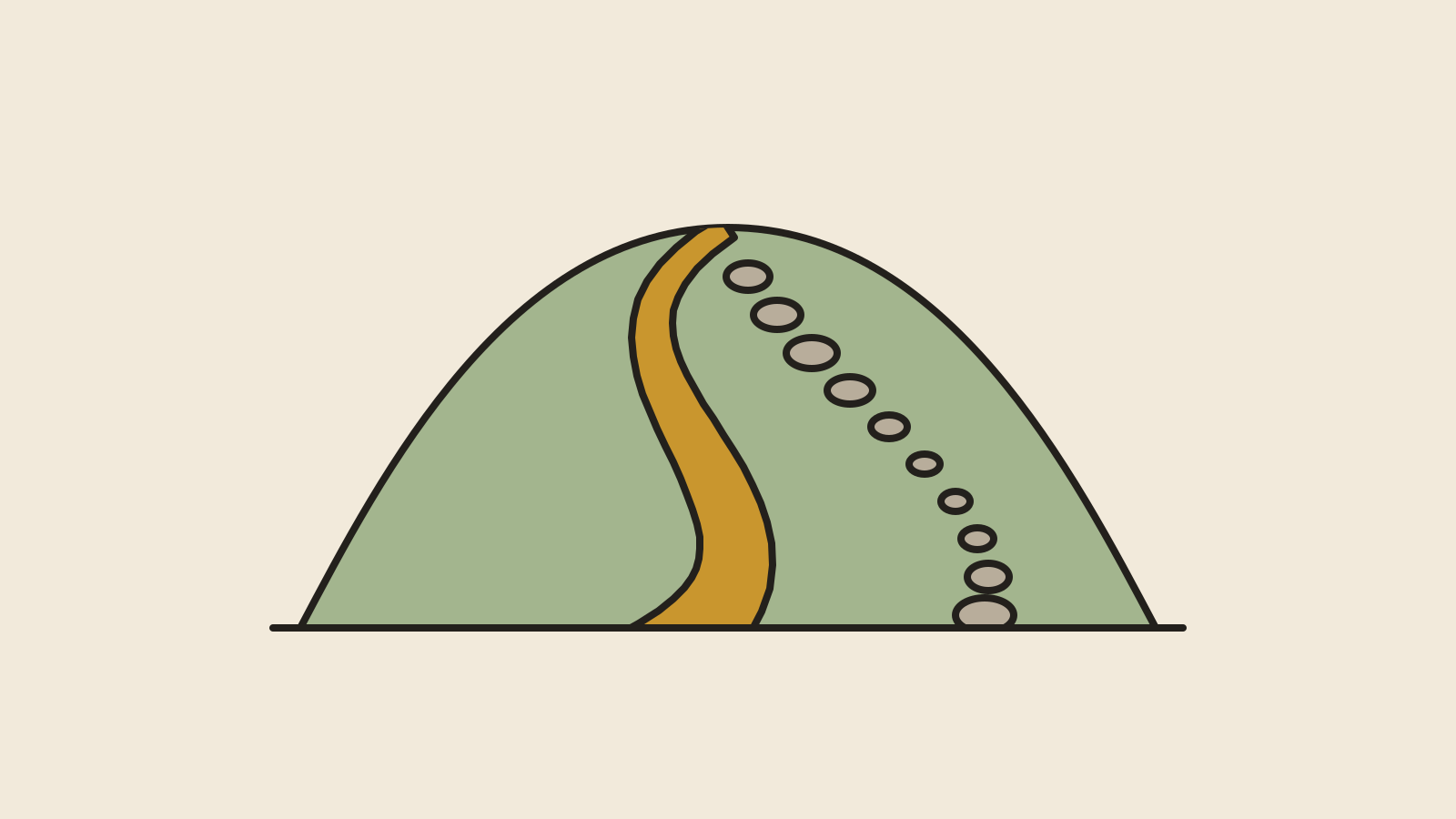
The brain's wiring changes with experience throughout life, strengthening connections that are used and weakening those that are not.
The idea
Neuroplasticity is the capacity of the nervous system to change its structure and its working in response to what it does and what happens to it. Connections between nerve cells grow stronger with use and weaker with neglect. New connections form and old ones are pruned. After an injury, a region can sometimes take on work it never did before.
London taxi drivers are the standard case. To earn a licence they spend years memorising some 25,000 streets. Brain scans published by Eleanor Maguire's team in 2000 found that the rear part of the hippocampus, a structure involved in spatial memory, was larger in drivers than in other people, and larger still in those who had driven longest.
For most of the twentieth century the adult brain was thought to be fixed once childhood ended. The evidence now runs the other way, though the brain is far from endlessly changeable.
Diagram
Use strengthens a connection, and a stronger connection is easier to use
Read as text
A loop of four steps. Repeated practice makes groups of nerve cells fire together. Cells that fire together strengthen the connection between them. A stronger connection lets the signal pass more easily, which makes the same cells more likely to fire together again. The loop reinforces itself. Without practice it runs the other way and the connection weakens.
Key features
- Change happens at several scales, from the strength of a single synapse (the junction between two nerve cells) to the redrawing of whole maps on the brain's surface.
- It is driven by activity: cells that repeatedly fire together strengthen their connection, a rule proposed by Donald Hebb in 1949.
- It runs in both directions, so unused connections weaken and skills fade.
- It is greatest in early life and continues, more slowly, in adulthood.
- It can harm as well as help, as when the changes underlie chronic pain or addiction.
Not to be confused with
| Look-alike | The difference | Differs on |
|---|---|---|
| Localisation of function | Localisation says particular regions do particular jobs. Plasticity says the assignment can shift with practice or injury. The two are compatible: the map is real, and it is drawn in pencil. | Differs onClaim |
| Critical period hypothesis | Plasticity is the general, lifelong capacity. A critical period is the claim that for one ability, such as language or vision with two eyes, the capacity is high during a window of childhood and falls sharply afterwards. | Differs onScope |
| Brain training | Commercial programmes promise that practising memory games will sharpen thinking in general. Plasticity predicts improvement at what is practised. Whether the gain carries over to untrained tasks is a separate claim, and trials mostly find that it doesn't. | Differs onClaim |
- Differs onClaim
Localisation says particular regions do particular jobs. Plasticity says the assignment can shift with practice or injury. The two are compatible: the map is real, and it is drawn in pencil.
- Differs onScope
Plasticity is the general, lifelong capacity. A critical period is the claim that for one ability, such as language or vision with two eyes, the capacity is high during a window of childhood and falls sharply afterwards.
- Differs onClaim
Brain training
Commercial programmes promise that practising memory games will sharpen thinking in general. Plasticity predicts improvement at what is practised. Whether the gain carries over to untrained tasks is a separate claim, and trials mostly find that it doesn't.
Origins and development
William James wrote in 1890 that nervous tissue is plastic and that habits are paths worn into it. The Polish physiologist Jerzy Konorski gave the term its modern sense in 1948, and Hebb proposed a mechanism a year later. Proof came slowly. David Hubel and Torsten Wiesel showed in the 1960s that a kitten's visual cortex rewires if one eye is kept closed. In 1973 Tim Bliss and Terje Lømo recorded lasting strengthening of synapses in rabbits. Michael Merzenich showed in the 1980s that the touch maps of adult monkeys reorganise after injury or training.
William James
The American psychologist and philosopher whose Principles of Psychology described the mind as a flowing, purposeful stream and who made pragmatism famous.
Why it matters
Stroke rehabilitation is built on it: intensive, repeated use of a weakened arm can recruit surviving tissue. It explains why a child who loses a large part of one hemisphere may still learn to speak, and why skills fade without practice. It also sells a great deal. Brain-training games, supplements and school programmes borrow the word, usually to promise more than the science supports.
Critiques and limits
The core claim is established. It has been confirmed in animals and people by cell recordings, imaging and recovery from injury. The disputes are about limits. Daniel Simons and colleagues reviewed the brain-training literature in 2016 and found little evidence that practised gains transfer to everyday thinking. Cibu Thomas and Chris Baker argued in 2013 that many imaging studies of training in adults had serious design flaws. Whether adult humans grow new neurons is contested: Shawn Sorrells's group reported in 2018 that they could find almost none in the hippocampus.
Connections
Belongs to
It is the branch's account of how learning, practice and injury leave physical traces in the nervous system.
Influenced by
In 1890 James called nervous tissue plastic and described habits as paths worn into it by repeated use.
Contrasts with
Critical period hypothesisCognitive science & linguistics
Differs on scope. Neuroplasticity is the brain's lifelong capacity to change, while the hypothesis claims that for language this capacity falls after childhood.
Differs on claim. Localisation says particular regions do particular jobs, where plasticity says that assignment can shift with practice or injury.
Applied in
ConnectionismCognitive science & linguistics
Hebb's rule that units active together strengthen their link became a basic learning rule in neural network models.
Language acquisitionCognitive science & linguistics
It explains why young children can still learn to speak after losing much of the left hemisphere.
Cross with
Two distant entries to read beside this one, each with the question the pairing opens.
Virtue ethicsPhilosophy
Aristotle held that we become just by doing just acts: does practice-driven rewiring of the brain show how habit becomes character? Set them side by side
SocialisationSociology
Socialisation is called lifelong: does the brain's continued rewiring set an age after which a society's rules are harder to absorb? Set them side by side
Further reading
- Costandi, M. (2016). Neuroplasticity. MIT Press. https://doi.org/10.7551/mitpress/10499.001.0001
- Hebb, D. O. (1949). The organization of behavior: A neuropsychological theory. Wiley.
- Maguire, E. A., Gadian, D. G., Johnsrude, I. S., Good, C. D., Ashburner, J., Frackowiak, R. S. J., & Frith, C. D. (2000). Navigation-related structural change in the hippocampi of taxi drivers. Proceedings of the National Academy of Sciences, 97(8), 4398–4403. https://doi.org/10.1073/pnas.070039597
- Simons, D. J., Boot, W. R., Charness, N., Gathercole, S. E., Chabris, C. F., Hambrick, D. Z., & Stine-Morrow, E. A. L. (2016). Do "brain-training" programs work?. Psychological Science in the Public Interest, 17(3), 103–186. https://doi.org/10.1177/1529100616661983
Cite this entry
Scholia. (2026). Neuroplasticity. In Scholia: Notes in the margin of the human sciences. Retrieved November 28, 2026, from https://scholia.zennia.sg/ideas/neuroplasticity