IdeaPhilosophyAlso in Sociology, Economics
Is–ought problem
Hume's observation that no list of facts about how things are can, by logic alone, yield a conclusion about how they ought to be.
The idea
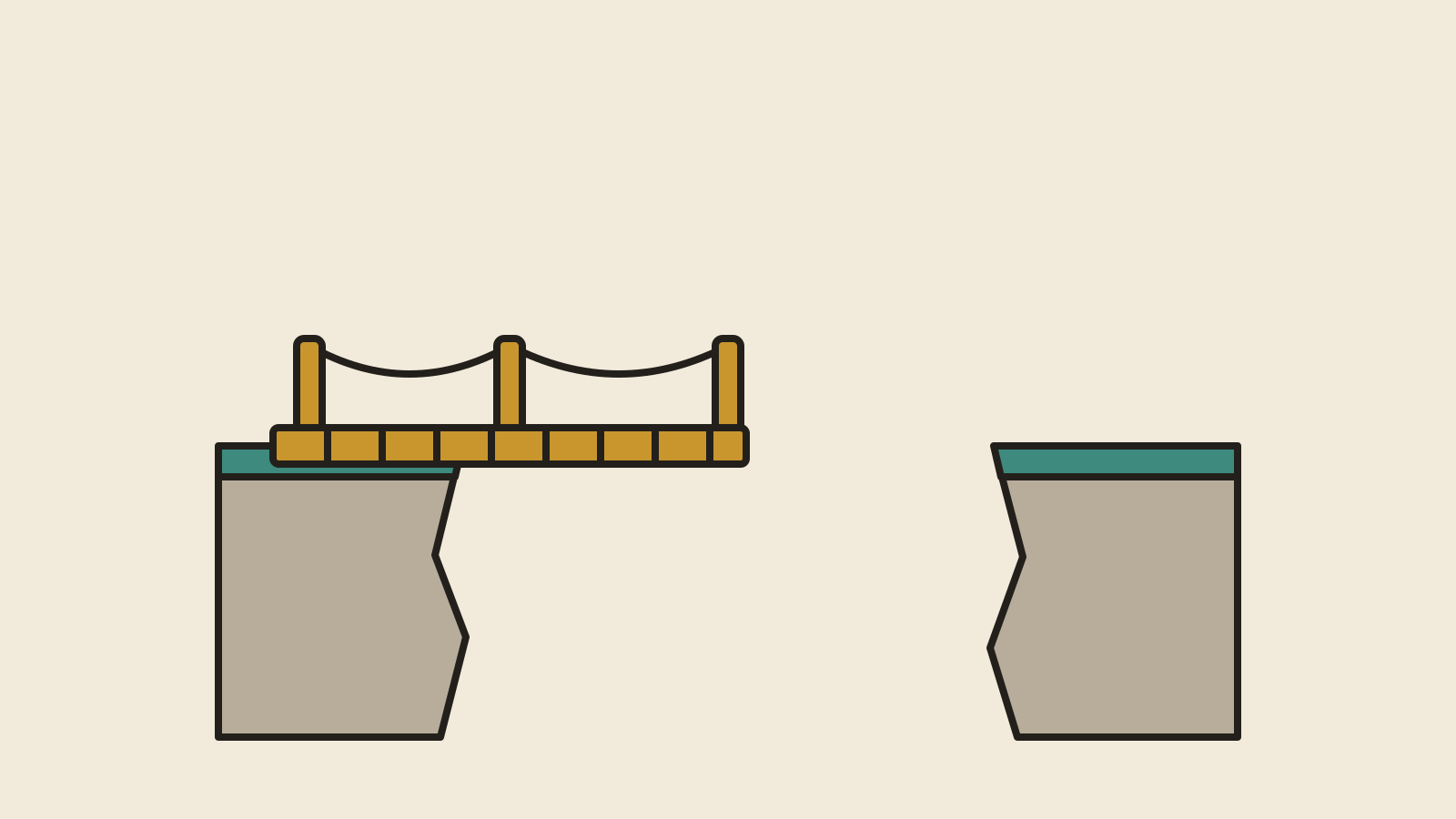
The is–ought problem is the gap between describing the world and saying what should be done in it. Statements about what is the case, however many are piled up, do not by themselves entail a statement about what anyone ought to do. To reach an ought, an argument needs at least one premise that already contains a value.
Take a familiar argument about diet. People have eaten meat for hundreds of thousands of years, and human teeth and guts are suited to it. So we ought to eat meat. Both premises may be true, and the conclusion still does not follow. It needs a further premise, that we ought to do what our ancestors did or what our bodies are suited to. That premise is a value claim, and it is the one in dispute. A vegetarian can accept every fact and reject it.
Diagram
A conclusion about what ought to be needs a value among its premises
Read as text
Two kinds of premise feed one conclusion. Factual premises state what is the case. A value premise states what matters or is owed. Only when both are present does a conclusion about what ought to be done follow. Factual premises on their own do not reach it.
Key features
- The point is logical, about what follows from what, and by itself says nothing on whether moral claims can be true.
- It allows arguments that mix facts and values, and blocks only the step from facts to an ought with no value premise.
- Facts stay relevant to ethics, since a value premise needs facts before it yields any particular conclusion.
- Arguments from what is natural, traditional or evolved are its usual targets.
- The slogan form, no ought from an is, is often called Hume's law.
Not to be confused with
| Look-alike | The difference | Differs on |
|---|---|---|
| Naturalistic fallacy | G. E. Moore's charge of 1903 that it is a mistake to define "good" as any natural property, such as pleasure. Moore's point is about definition. Hume's is about inference from premises to a conclusion. | Differs onClaim |
| Fact-value distinction | The broader doctrine that statements divide into factual ones and evaluative ones. Hume's point about inference is narrower, and someone who thinks words like "cruel" are both at once can still accept it. | Differs onScope |
| Natural law | The tradition holding that what is good for human beings can be read from human nature. Critics say this crosses the gap. Defenders reply that practical reason starts from goods already grasped as worth pursuing. | Differs onClaim |
| Problem of induction | Hume's other famous gap. That one lies between observed cases and unobserved ones, and concerns factual belief. This one lies between facts of any kind and values. | Differs onClaim |
- Differs onClaim
Naturalistic fallacy
G. E. Moore's charge of 1903 that it is a mistake to define "good" as any natural property, such as pleasure. Moore's point is about definition. Hume's is about inference from premises to a conclusion.
- Differs onScope
Fact-value distinction
The broader doctrine that statements divide into factual ones and evaluative ones. Hume's point about inference is narrower, and someone who thinks words like "cruel" are both at once can still accept it.
- Differs onClaim
The tradition holding that what is good for human beings can be read from human nature. Critics say this crosses the gap. Defenders reply that practical reason starts from goods already grasped as worth pursuing.
- Differs onClaim
Hume's other famous gap. That one lies between observed cases and unobserved ones, and concerns factual belief. This one lies between facts of any kind and values.
Origins and development
David Hume raised the point in a single paragraph of his Treatise of Human Nature, in the third book, published in 1740. He remarked that moral writers move from sentences joined by "is" to sentences joined by "ought" without explaining the change. In the twentieth century R. M. Hare named the principle Hume's law, and Max Black called it Hume's guillotine. The logical positivists and many economists made it a boundary between science and ethics. Alasdair MacIntyre argued in 1959 that Hume never meant to forbid every such inference, and the passage's meaning is still debated.
David Hume
A Scottish philosopher who argued that our beliefs about causes, the self and morality rest on habit and feeling more than on reason.
Logical positivism
A movement of the 1920s and 1930s holding that a statement is meaningful only if it is true by definition or testable by experience.
Why it matters
The gap is why economists separate positive economics, which describes how the economy works, from normative economics, which says what policy should aim at. Max Weber drew on it to argue that social science cannot tell people what to value. It is also the standard reply when someone argues from "natural" to "right", whether the subject is diet, sex roles or inequality.
Max Weber
A German scholar who made sociology the study of meaningful action and traced how calculation and rules came to organise modern life.
Critiques and limits
John Searle argued in 1964 that institutional facts bridge it. From the fact that Jones uttered a promise, it follows by the rules of promising that he ought to keep it. Critics reply that accepting the institution is itself a value commitment. Philippa Foot and Hilary Putnam argued that "thick" terms such as rude or cruel describe and evaluate at once, so the two cannot be pulled apart. Most philosophers accept a qualified version of the logical point. What it shows about ethics is a conceptual question, still argued.
Connections
Belongs to
It is a founding problem of metaethics, which asks how moral claims relate to facts and to reasoning.
Originated by
Hume raised it in one paragraph of the Treatise, noting that moralists slide from is to ought without explanation.
Contrasts with
Differs on claim. Natural law holds that human nature shows what is good, the kind of step from fact to value that Hume questioned.
Differs on claim. Induction's gap lies between observed and unobserved facts, where this gap lies between facts of any kind and values.
Applied in
Public and welfare economicsEconomics
Economists rely on the gap to separate positive analysis of how markets work from normative judgements about policy goals.
Sociological methodsSociology
Weber's case for value-free social science rests on it, since research can establish facts and cannot rank ultimate values.
Influenced
The gap between statements of fact and statements of value is the puzzle most metaethical theories try to explain.
Cross with
Two distant entries to read beside this one, each with the question the pairing opens.
Pareto efficiencyEconomics
An outcome is Pareto efficient when nobody can gain without another losing: what extra premise turns that description into a recommendation? Set them side by side
Stages of moral developmentPsychology
Kohlberg holds that later stages of moral reasoning are more mature, not just later: what licenses the step from a developmental order to a ranking? Set them side by side
Further reading
- Hume, D. (2000). A treatise of human nature. Oxford University Press. (Original work published 1739)
- MacIntyre, A. C. (1959). Hume on "is" and "ought". The Philosophical Review, 68(4), 451–468. https://doi.org/10.2307/2182491
- Putnam, H. (2002). The collapse of the fact/value dichotomy and other essays. Harvard University Press.
- Searle, J. R. (1964). How to derive "ought" from "is". The Philosophical Review, 73(1), 43–58. https://doi.org/10.2307/2183201
Cite this entry
Scholia. (2026). Is–ought problem. In Scholia: Notes in the margin of the human sciences. Retrieved November 28, 2026, from https://scholia.zennia.sg/ideas/is-ought-problem