IdeaAnthropologyAlso in Sociology, Psychology
Purity and pollution
Douglas's claim that things count as dirty or polluting when they fall outside a society's categories, so rules of purity defend its sense of order.
The idea
Mary Douglas's claim is that dirt has no existence of its own. Things are dirty relative to an order: they are in the wrong place, or they fit no place at all. Every society sorts the world into categories, and whatever blurs or crosses them is felt to be polluting and often dangerous. Rules about purity, on this view, defend the boundaries of a shared scheme. Explanations in terms of germs arrived late, and the avoidance is far older.
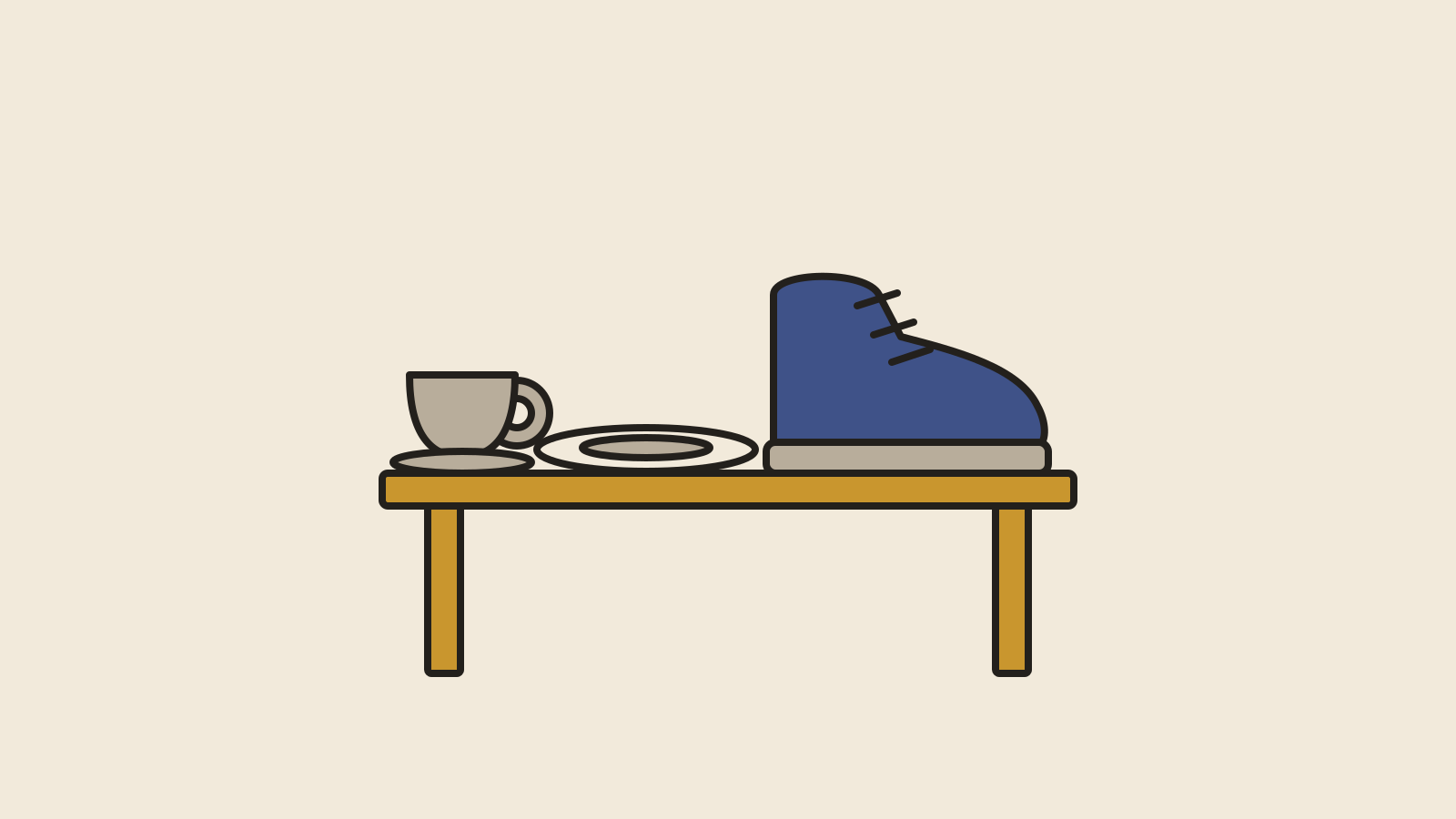
Shoes show how it works. On the floor by the door they offend nobody, but put the same shoes on the dining table and people recoil, though the table may be as clean as before. Hair on a head is admired, and a single hair in the soup ruins the meal. Douglas saw the same logic in religious law. She argued that Leviticus forbids the pig because it has the cloven hoof of proper livestock but does not chew the cud.
Diagram
Dirt is what a system of categories cannot place
Read as text
A flow of four steps with a loop. A society shares a system of categories. Something turns up that fits none of them or crosses between two. People feel it as dirt or as a danger. Rules of avoidance and cleansing restore the boundary, and an arrow leads back to the first step, because keeping the rules reaffirms the system of categories.
Key features
- Dirt is relative: nothing is unclean in itself, only out of place within some system.
- Anomalies attract the strongest rules, whether animals that straddle two classes or people between two statuses.
- The edges of the body carry special charge, so spittle, blood and nail clippings are widely treated as dangerous.
- The body stands for society, and groups anxious about their borders tend to police what enters and leaves the body.
- Modern hygiene and ancient ritual share one logic, though the first cites germs and the second spirits.
Not to be confused with
| Look-alike | The difference | Differs on |
|---|---|---|
| Taboo | Taboo is the name for a kind of prohibition and explains nothing. Douglas's idea is an explanation: such prohibitions cluster where a society's categories are under threat. | Differs onClaim |
| Sacred and profane | Durkheim's pair sorts things by whether they are set apart at all. Douglas asks what makes a thing unclean, and her answer is a breach of categories. A sacred thing can pollute. | Differs onClaim |
| Stigma | Stigma is a mark of discredit on a person's identity. Pollution belongs to a system of classification, and can attach to foods, places, acts and times as well as people. | Differs onUnit of analysis |
| Disgust | Disgust is an emotion, which many psychologists trace to evolved defences against disease. Douglas's pollution is a judgement about order, and can be made coolly about things that revolt nobody. | Differs onMechanism |
- Differs onClaim
Taboo is the name for a kind of prohibition and explains nothing. Douglas's idea is an explanation: such prohibitions cluster where a society's categories are under threat.
- Differs onClaim
Durkheim's pair sorts things by whether they are set apart at all. Douglas asks what makes a thing unclean, and her answer is a breach of categories. A sacred thing can pollute.
- Differs onUnit of analysis
Stigma is a mark of discredit on a person's identity. Pollution belongs to a system of classification, and can attach to foods, places, acts and times as well as people.
- Differs onMechanism
Disgust
Disgust is an emotion, which many psychologists trace to evolved defences against disease. Douglas's pollution is a judgement about order, and can be made coolly about things that revolt nobody.
Origins and development
Douglas published Purity and Danger in 1966, drawing on fieldwork among the Lele of the Congo. They honoured the pangolin, a scaly mammal that fits none of their animal classes. The phrase "matter out of place" was already an old saying when she took it up. In Natural Symbols (1970) she tied styles of purity rule to types of society. She later withdrew her reading of Leviticus and offered a new one in 1999.
Why it matters
The idea explains reactions that hygiene can't, such as why a sterilised cockroach dipped in a drink still spoils it, or why food rules mark who belongs. It is used to study caste, kosher and halal rules, attitudes to migrants and the language of "cleansing" in politics. Douglas herself carried it into the study of risk, arguing that groups fear the dangers that threaten their way of life.
Critiques and limits
Anna Meigs objected that most things out of place are merely untidy. On her New Guinea evidence, what pollutes is decaying matter from other bodies that threatens to enter one's own. Marvin Harris explained the pig ban by the cost of raising pigs in a dry land. Valerie Curtis argued that disgust is an evolved defence against infection, so much dirt is really harmful. The idea is interpretive: it makes sense of many cases, and can't be tested like a law of nature.
Connections
Belongs to
Anthropology of religion and ritual
The idea is the branch's best-known account of why religions rule on food, bodies and contact.
Originated by
Douglas set out the argument in Purity and Danger (1966), from her Lele fieldwork and a reading of Leviticus.
Influenced by
Émile DurkheimSociology
Douglas took from Durkheim the view that a society's categories of thought reflect and uphold its social order.
Critiques
Douglas rejected the Victorian view that pollution fears belong to primitive minds, and found the same logic in modern hygiene.
Contrasts with
Differs on claim. Taboo names a kind of prohibition, where Douglas's idea explains such prohibitions as defences of a society's categories.
Sacred and profaneSociology
Differs on claim. Durkheim's pair sorts things by whether they are set apart, where Douglas explains uncleanness as a breach of categories.
StigmaSociology
Differs on unit of analysis. Stigma marks a person's identity, where pollution belongs to a classification and can attach to foods, places and acts.
Applied in
Social psychologyPsychology
Research on moral disgust tests how far feelings of contamination shape judgements of right and wrong.
Cross with
Two distant entries to read beside this one, each with the question the pairing opens.
Prototype theoryCognitive science & linguistics
Are the things a society finds polluting the ones prototype theory would score as poor examples of every category? Set them side by side
Harm principlePolitical theory & science
Can breaking a purity rule ever count as harm to others in the sense Mill's harm principle requires? Set them side by side
Further reading
- Curtis, V. (2013). Don't look, don't touch: The science behind revulsion. Oxford University Press. https://doi.org/10.7208/chicago/9780226089102.001.0001
- Douglas, M. (1966). Purity and danger: An analysis of concepts of pollution and taboo. Routledge & Kegan Paul.
- Fardon, R. (1999). Mary Douglas: An intellectual biography. Routledge.
Cite this entry
Scholia. (2026). Purity and pollution. In Scholia: Notes in the margin of the human sciences. Retrieved November 28, 2026, from https://scholia.zennia.sg/ideas/purity-and-pollution