PersonPsychology
Hans Eysenck
German-born British psychologist who reduced personality to a few measurable dimensions, attacked psychoanalysis and left a record marked by disputes and retractions.
Why they matter
Hans Eysenck argued that personality can be measured as height can, and that a few dimensions rooted in the nervous system describe it. From questionnaires answered by thousands of people he drew two. Extraversion runs from outgoing to reserved. Neuroticism runs from emotionally steady to easily upset. A third, psychoticism, came later.
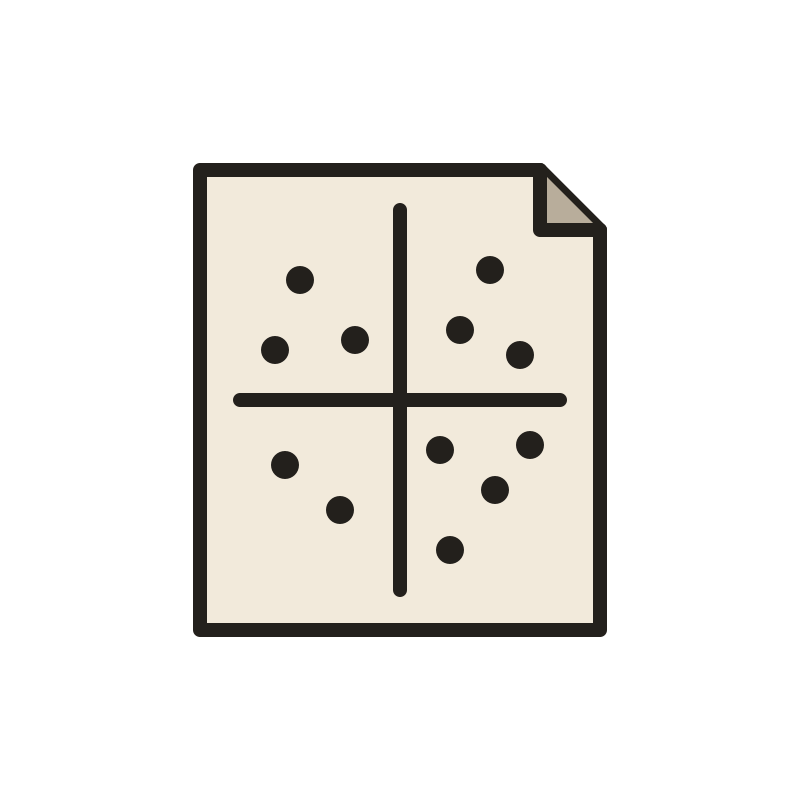
The scheme is easy to picture. Take four colleagues: the cheerful organiser of every office party, the touchy one who also loves a crowd, the calm one who eats lunch alone and the worrier who does the same. Two crossed lines give each of them a place on a chart. Eysenck claimed that their brains differ in ways a laboratory can detect.
He was also the most combative British psychologist of his time. He attacked psychoanalysis, pressed for behaviour therapy and defended views on race and intelligence that brought protests. Part of his later work has since been judged unsafe.
Key ideas
- Extraversion and neuroticism: two independent traits on which everyone has a position, measured by short questionnaires.
Personality trait
A lasting tendency to feel, think and act in a certain way, which shows up across many situations and differs by degree between people.
- Psychoticism: a third dimension, added later, that runs from warm and considerate to cold and aggressive.
- Arousal theory: introverts have more easily aroused brains, so they seek less stimulation than extraverts.
- The psychotherapy challenge: his 1952 review claimed that about two thirds of neurotic patients recover within two years, treated or not.
- Behaviour therapy: neurotic symptoms are learned habits, to be unlearned by methods taken from conditioning.
Not to be confused with
| Look-alike | The difference | Differs on |
|---|---|---|
| Gordon Allport | Allport looked for the traits that organise a single person and distrusted averages. Eysenck used factor analysis, a statistic that finds a few dimensions behind many test answers, and tied them to biology. | Differs onMethod |
| Carl Jung | Jung brought introvert and extravert into psychology as two types of people, defined by where their interest flows. Eysenck made extraversion one continuous scale with most people near the middle. | Differs onClaim |
| Five-factor model | Eysenck held that three dimensions are enough. The five-factor model keeps his extraversion and neuroticism, drops psychoticism and adds agreeableness, conscientiousness and openness. | Differs onClaim |
| Raymond Cattell | Cattell applied the same statistics and arrived at sixteen narrower traits. Eysenck replied that these overlap and collapse into his few broad ones. | Differs onClaim |
- Differs onMethod
Allport looked for the traits that organise a single person and distrusted averages. Eysenck used factor analysis, a statistic that finds a few dimensions behind many test answers, and tied them to biology.
- Differs onClaim
Jung brought introvert and extravert into psychology as two types of people, defined by where their interest flows. Eysenck made extraversion one continuous scale with most people near the middle.
- Differs onClaim
Eysenck held that three dimensions are enough. The five-factor model keeps his extraversion and neuroticism, drops psychoticism and adds agreeableness, conscientiousness and openness.
- Differs onClaim
Raymond Cattell
Cattell applied the same statistics and arrived at sixteen narrower traits. Eysenck replied that these overlap and collapse into his few broad ones.
Life and context
Eysenck was born in Berlin in 1916 to two actors and was raised by his grandmother. He left Germany in 1934, opposed to the Nazi regime, and studied psychology at University College London under Cyril Burt. During the war he worked at Mill Hill Emergency Hospital. Records of 700 soldiers with neurotic breakdowns gave him his first two dimensions. From 1955 to 1983 he was professor of psychology at the Institute of Psychiatry in London.
He wrote about eighty books, many for general readers. In Race, Intelligence and Education (1971) he argued that the gap in average IQ scores between black and white Americans was partly genetic. He said he was reporting evidence and that it justified no discrimination. Opponents said the evidence could not carry the conclusion and that the claim did harm. In 1973 protesters assaulted him during a lecture in London.
Life strip
- 1916 Born
- 1916 Born to two actors, Berlin
- 1934 Leaves Nazi Germany and settles in England, London
- 1940 Takes his doctorate under Cyril Burt, University College London
- 1947 Publishes Dimensions of Personality
- 1952 Publishes his review of the effects of psychotherapy
- 1955 Becomes professor of psychology at the Institute of Psychiatry, London
- 1967 Publishes The Biological Basis of Personality
- 1971 Publishes Race, Intelligence and Education
- 1997 Dies aged 81, London
- 1997 Died
Legacy
Extraversion and neuroticism appear, under one name or another, in the main later models of personality. Behaviour therapy grew into cognitive behavioural therapy, now the main talking treatment in Britain's health service. His 1952 paper pushed psychotherapists to run controlled trials. He founded two journals that are still published, and for years he was among the most cited psychologists in the world.
Cognitive behavioural therapy
A family of short, structured talking treatments that ease distress by changing unhelpful habits of thinking and behaving, tested in more trials than any other.
Critiques and limits
Mary Smith and Gene Glass pooled 375 studies in 1977 and found that psychotherapy works, against his 1952 claim. Jeffrey Gray, his successor, redrew his dimensions around anxiety and impulsivity. Leon Kamin, who debated him in a 1981 book, held that the twin data were unsound and that nothing tied the gap between groups to genes. Anthony Pelosi showed that his studies with Ronald Grossarth-Maticek, which claimed that personality predicts death from cancer, reported implausible results. In 2019 King's College London judged 26 of those papers unsafe, and journals have since retracted more than a dozen.
Lineage
Influenced by

Influenced
Connections
Belongs to
Personality and individual differences
His two dimensions, extraversion and neuroticism, became fixed points of the main later trait models.
He set up Britain's first clinical psychology training and demanded proof that treatments work.
He traced differences in personality to arousal systems in the brain and to inheritance.
Influenced by
He borrowed Pavlov's excitation and inhibition to explain why introverts form conditioned responses more readily than extraverts.
Critiques
He called it unscientific and argued in 1952 that its patients recovered no faster than people left untreated.
Contrasts with
Differs on claim. Jung described introverts and extraverts as two types, while Eysenck made extraversion one continuous, measured dimension.
Differs on method. Allport sought the traits that organise one person, while Eysenck used factor analysis on thousands to find a few dimensions.
Five-factor model of personality
Differs on claim. Eysenck held that three dimensions describe personality, while the model keeps two of his and counts five.
Influenced
Five-factor model of personality
The model keeps Eysenck's extraversion and neuroticism as two of its five factors, though he held that three suffice.
Further reading
Read first
Eysenck, H. J. (1952). The effects of psychotherapy: An evaluation. Journal of Consulting Psychology, 16(5), 319–324. https://doi.org/10.1037/h0063633
- Buchanan, R. D. (2010). Playing with fire: The controversial career of Hans J. Eysenck. Oxford University Press.
- Eysenck, H. J. (1947). Dimensions of personality. Kegan Paul, Trench, Trubner.
- Pelosi, A. J. (2019). Personality and fatal diseases: Revisiting a scientific scandal. Journal of Health Psychology, 24(4), 421–439. https://doi.org/10.1177/1359105318822045
Cite this entry
Scholia. (2026). Hans Eysenck. In Scholia: Notes in the margin of the human sciences. Retrieved November 28, 2026, from https://scholia.zennia.sg/people/hans-eysenck
This topic is contested. The entry sets out the main positions rather than settling them.