School or branchSociologyAlso in Anthropology
Chicago School (sociology)
The University of Chicago sociologists who, from the 1910s to the 1930s, treated the city as a laboratory and studied it at first hand.
Overview
The Chicago School was the group of sociologists at the University of Chicago who, between about 1915 and 1935, made the city their subject and first-hand research their method. Chicago had grown from a frontier town to a city of more than two million within a single lifetime, mostly through migration. Robert Park, a former newspaper reporter, sent his students out to map it and to spend time with its hobos, gangs and dance hall workers.
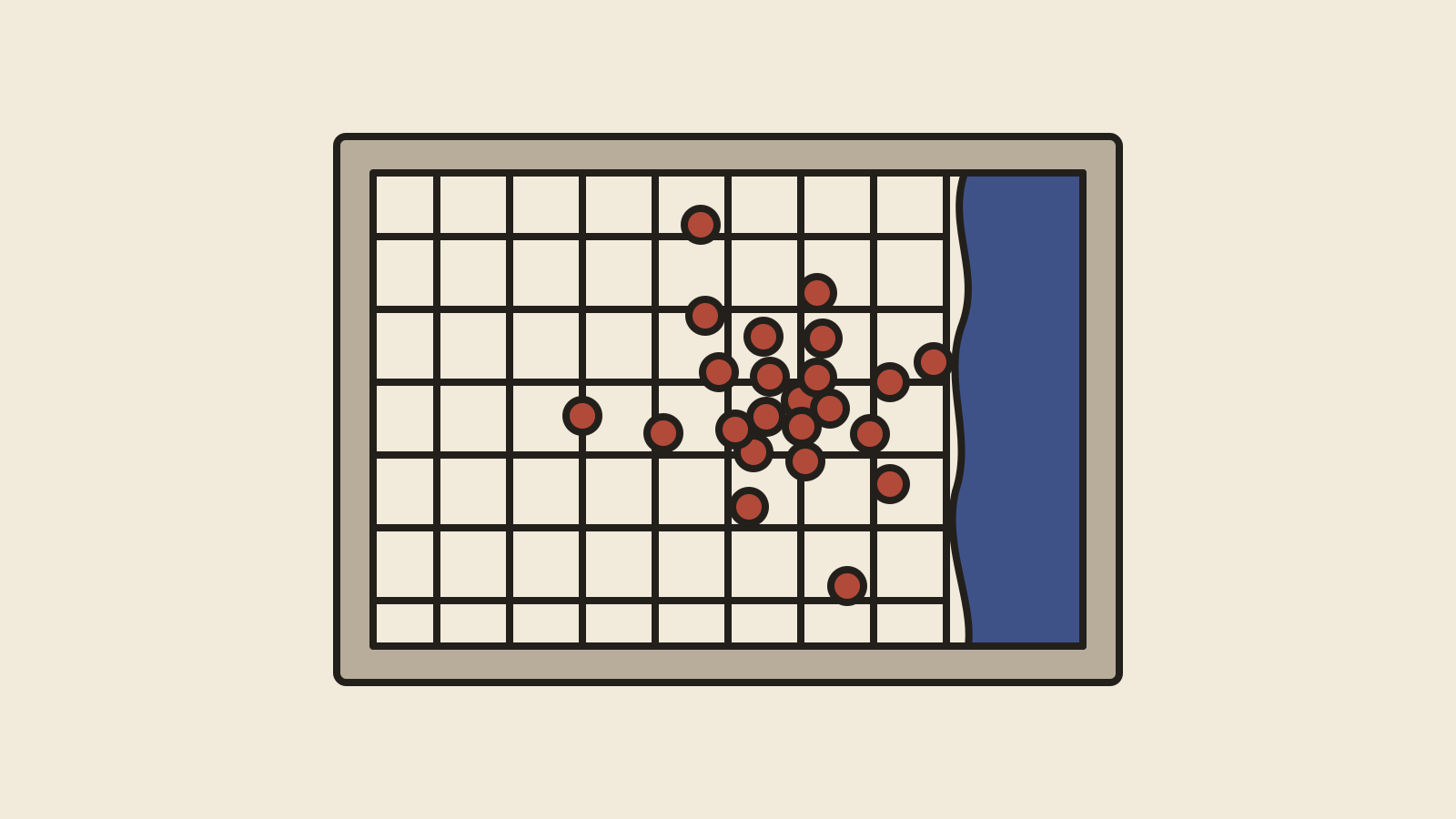
Anyone who has heard a district called "a bad area" has met the school's best-known finding. Clifford Shaw and Henry McKay plotted the home addresses of thousands of boys sent to juvenile court. The same inner districts had the highest rates decade after decade, although the people living there changed from German and Irish to Polish and Italian. The cause, they argued, lay in the neighbourhood, where poverty and constant turnover weakened the ties that let adults keep order.
Diagram
Burgess pictured the city growing outward in five rings
Read as text
Five concentric rings. The innermost is the central business district, which Burgess called the Loop. Round it lies the zone in transition, an area of factories and cheap lodgings where newcomers settle and where the school found the highest rates of crime. Next come working-class homes, then a residential zone of better housing, then an outer commuter zone. Each ring tends to push outward into the next as the city grows.
Core commitments
- The city is a natural laboratory in which social processes can be watched directly.
- Researchers should go and look, combining maps, case files, life histories and participant observation.
Participant observation
Studying a group by taking part in its daily life over a long period while watching and recording what goes on.
- Groups compete for urban space much as plant species do, which sorts a city into distinct "natural areas". Park called this human ecology.
- Crime and family breakdown come from the disorganisation of a place and not from the biology or origin of its residents.
- Contact between ethnic groups passes through competition and conflict towards accommodation and assimilation.
Not to be confused with
| Look-alike | The difference | Differs on |
|---|---|---|
| Chicago School (economics) | The economists gathered around Milton Friedman and George Stigler from the 1940s shared the university and nothing else. Theirs is a body of free-market price theory built on the rational individual. The sociologists studied neighbourhoods and groups by fieldwork. | Differs onUnit of analysis |
| Atlanta School (sociology) | Du Bois's group at Atlanta began community studies two decades earlier and traced racial inequality to discrimination and history. Park's race relations cycle treated it as a natural process that would end in assimilation. | Differs onClaim |
| Symbolic interactionism | Interactionism is a theory of meaning and the self that grew up at Chicago. The school is wider and includes mapping, statistics and urban ecology. A post-war "second Chicago School" of fieldworkers is close to interactionism, which adds to the muddle. | Differs onScope |
- Differs onUnit of analysis
Chicago School (economics)
The economists gathered around Milton Friedman and George Stigler from the 1940s shared the university and nothing else. Theirs is a body of free-market price theory built on the rational individual. The sociologists studied neighbourhoods and groups by fieldwork.
- Differs onClaim
Du Bois's group at Atlanta began community studies two decades earlier and traced racial inequality to discrimination and history. Park's race relations cycle treated it as a natural process that would end in assimilation.
- Differs onScope
Interactionism is a theory of meaning and the self that grew up at Chicago. The school is wider and includes mapping, statistics and urban ecology. A post-war "second Chicago School" of fieldworkers is close to interactionism, which adds to the muddle.
Origins and development
Albion Small founded the department in 1892, the first of its kind in the United States. W. I. Thomas and Florian Znaniecki showed what letters and a life history could do in The Polish Peasant in Europe and America (1918–1920). Park arrived in 1914 and published his programme for studying the city in 1915. With Ernest Burgess he trained a generation whose monographs include The Hobo, The Gang and The Ghetto. Burgess drew the city as five rings in 1925. The department's lead ended in the mid-1930s, as Park retired, survey research rose at Columbia and grand theory at Harvard.
Why it matters
Urban sociology, criminology and qualitative fieldwork all carry its mark. The view that neighbourhoods shape lives independently of the people in them guides research on poverty and policing, most fully in Robert Sampson's long study of Chicago published in 2012. Shaw's Chicago Area Project of 1934, which hired local residents to work with young people, became a model for community crime prevention.
Critiques and limits
Homer Hoyt showed in 1939 that American cities grow in wedges along transport routes more than in rings. Manuel Castells argued in 1972 that talk of natural areas hides the decisions of landlords, banks and governments that sort people into districts. Mary Jo Deegan documented in 1988 how the school took mapping methods from the women of Jane Addams's Hull-House and then classed those women as social workers. Aldon Morris charged in 2015 that Park ignored Du Bois's earlier research.
Key figures
- Albion Small
- W. I. Thomas
- Robert Park
- Ernest Burgess
- Louis Wirth
- Clifford Shaw
- E. Franklin Frazier
- Everett Hughes
Connections
Influenced by
Park heard Simmel lecture in Berlin and brought home his interest in the stranger, the crowd and city life.
Pragmatism (philosophy)Philosophy
Dewey and Mead taught at Chicago, and their view that knowledge comes from practical inquiry shaped the department's empirical habits.
Ethnographic methodAnthropology
Park urged students to study city neighbourhoods with the patient observation anthropologists had used in distant villages.
Franz BoasAnthropology
W. I. Thomas took from Boas the case that group differences are learned, which turned Chicago sociology away from racial explanation.
Contrasts with
Differs on claim. Atlanta traced racial inequality to discrimination and history, while Chicago's race relations cycle treated it as a natural process ending in assimilation.
Differs on scope. Interactionism is one theory of meaning and the self that grew at Chicago, while the school also covers mapping, statistics and urban ecology.
Yenching school (Chinese community studies)Anthropology
Differs on unit of analysis. Chicago's communities were neighbourhoods of an industrial city, Yenching's were farming villages and market towns.
Contains
He trained in the post-war Chicago department under Everett Hughes and kept its taste for fieldwork.
He belonged to the post-war Chicago generation that learned fieldwork from Everett Hughes and Herbert Blumer.
Influenced
Fei XiaotongAnthropology
Robert Park taught at Yenching in 1932 and turned Fei's cohort towards first-hand community studies.
Chicago sociologists mapped delinquency onto city neighbourhoods, making place and social disorganisation standard explanations of crime.
Ethnographic methodAnthropology
Robert Park's students took fieldwork into city neighbourhoods and made ethnography a sociological method as well.
Chicago sociologists of the 1920s made first-hand fieldwork in the city a standard way of working.
Chicago's habit of first-hand fieldwork gave the school its preferred method and most of its first members.
Yenching school (Chinese community studies)Anthropology
Robert Park's term at Yenching in 1932 inspired the turn to first-hand community studies.
Strauss was trained in the Chicago tradition of fieldwork, which supplied the habit of building concepts from observed cases.
Merton built on the Chicago sociologist W. I. Thomas's point that situations defined as real have real consequences.
Applications
Chicago's urban sociologists used the pair to ask what city life does to personal ties.
Participant observationAnthropology
Chicago sociologists used it from the 1920s to study gangs, taxi-dance halls and homeless men in the city.
Cross with
Two distant entries to read beside this one, each with the question the pairing opens.
Japanese native ethnology (minzokugaku)Anthropology
Yanagita studied his own country's ordinary people while Chicago studied its own city: what does studying home hide that studying strangers shows? Set them side by side
Spontaneous orderEconomics
Chicago sociologists studied city neighbourhoods that nobody designed: is a city's social layout a spontaneous order, and who bears its costs? Set them side by side
Further reading
- Bulmer, M. (1984). The Chicago school of sociology: Institutionalization, diversity, and the rise of sociological research. University of Chicago Press.
- Park, R. E., Burgess, E. W., & McKenzie, R. D. (1925). The city. University of Chicago Press.
- Park, R. E. (1915). The city: Suggestions for the investigation of human behavior in the city environment. American Journal of Sociology, 20(5), 577–612. https://doi.org/10.1086/212433
- Shaw, C. R., & McKay, H. D. (1942). Juvenile delinquency and urban areas: A study of rates of delinquents in relation to differential characteristics of local communities in American cities. University of Chicago Press.
Cite this entry
Scholia. (2026). Chicago School (sociology). In Scholia: Notes in the margin of the human sciences. Retrieved November 28, 2026, from https://scholia.zennia.sg/schools/chicago-school-sociology