School or branchSociologyAlso in Psychology
Symbolic interactionism
The sociological school holding that people act on the meanings things have for them, and that those meanings are made in interaction.
Overview
Symbolic interactionism holds that people respond to what things mean to them, and that meanings are worked out with other people. Society, on this view, is something people do together, one encounter after another.
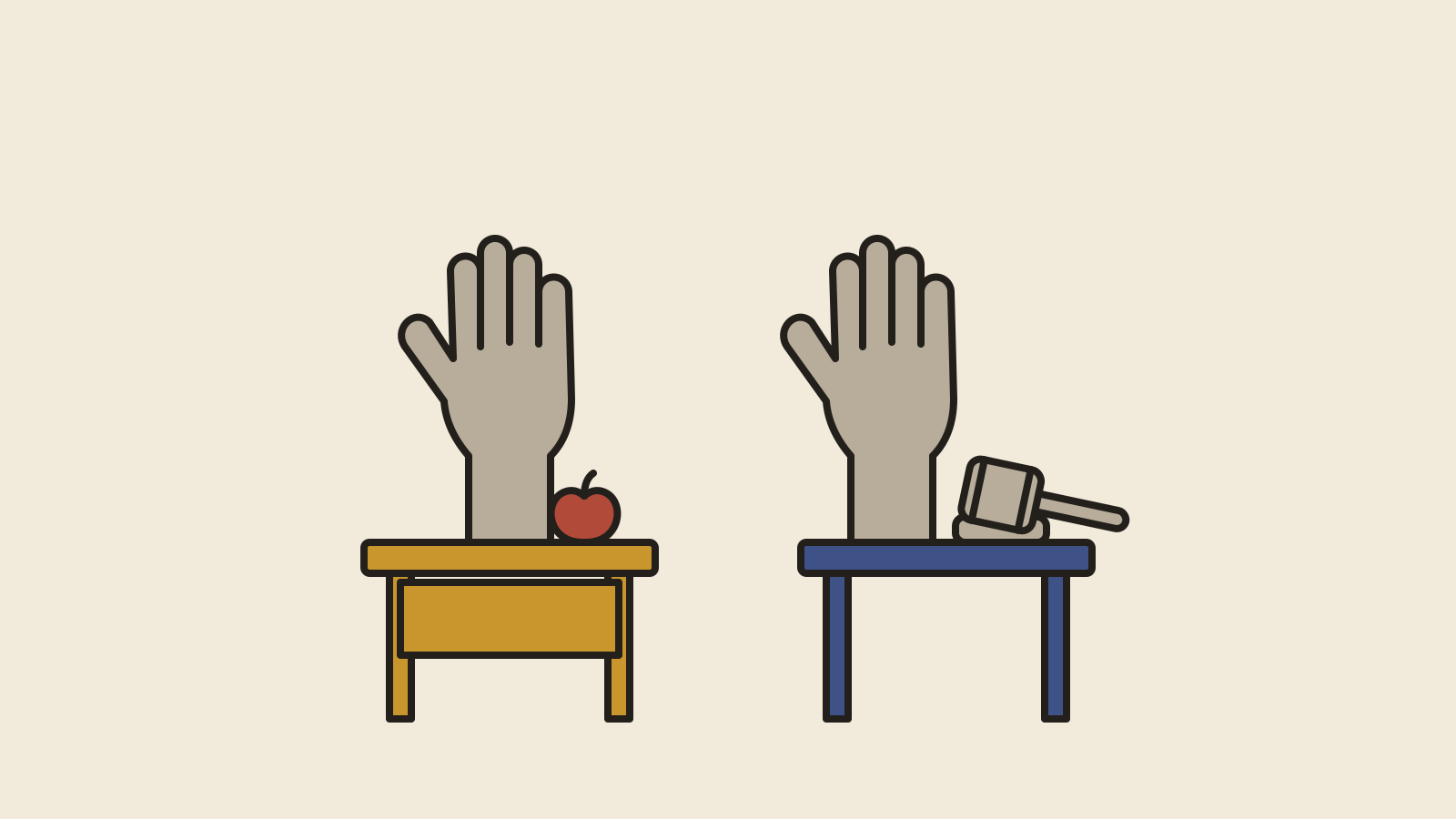
Take a raised hand. In a classroom it asks for permission to speak, at an auction it registers a bid and on a street corner it hails a taxi. The gesture is physically identical each time. What it counts as depends on how those present define the situation, and a newcomer has to learn that definition before acting on it.
Interactionists study how such definitions are established, maintained and changed. They ask how a medical student comes to feel like a doctor, or how a pupil called a troublemaker begins to play the part. They treat the self the same way, as something a person acquires by imagining how they appear to others.
Diagram
Meanings are made in interaction and remade each time people act
Read as text
A cycle of four stages round a centre labelled definition of the situation. Dealings with other people give rise to shared meanings. A person uses those meanings to interpret the situation in front of them, then acts on that interpretation. The action is itself a new dealing with other people, so the loop begins again and meanings can shift with each round.
Core commitments
- People act towards things according to the meanings those things have for them.
- Meanings arise from dealings with other people and are not fixed in the things themselves.
- People handle and revise meanings by interpreting each situation, so conduct can't be read off from rules or roles.
- The self is social, since it forms as a person learns to see themselves from the standpoint of others.
- Research should stay close to lived situations, through fieldwork, long interviews and life histories.
Not to be confused with
| Look-alike | The difference | Differs on |
|---|---|---|
| Ethnomethodology | Interactionists ask what a situation means to the people in it and how their selves take shape. Ethnomethodologists set meaning and motive aside and study the practical methods by which people make a scene orderly at all. | Differs onUnit of analysis |
| Functionalism (sociology) | Functionalists treat roles and norms as given by the social system and learned by its members. Interactionists say a role is a loose outline that people interpret, negotiate and sometimes rewrite. | Differs onClaim |
| Conflict theory | Conflict theorists work at the scale of classes, organisations and states. Interactionists work at the scale of the encounter. | Differs onLevel |
| Social constructionism | Constructionism is a general claim that many apparent facts of nature are products of human agreement. Interactionism is one school that studies how meanings are made face to face, and it fed that wider claim. | Differs onScope |
- Differs onUnit of analysis
Interactionists ask what a situation means to the people in it and how their selves take shape. Ethnomethodologists set meaning and motive aside and study the practical methods by which people make a scene orderly at all.
- Differs onClaim
Functionalists treat roles and norms as given by the social system and learned by its members. Interactionists say a role is a loose outline that people interpret, negotiate and sometimes rewrite.
- Differs onLevel
Conflict theorists work at the scale of classes, organisations and states. Interactionists work at the scale of the encounter.
- Differs onScope
Constructionism is a general claim that many apparent facts of nature are products of human agreement. Interactionism is one school that studies how meanings are made face to face, and it fed that wider claim.
Origins and development
The roots lie in American pragmatism. George Herbert Mead lectured at Chicago on how the self arises in social life, and the lectures were published from students' notes in 1934, after his death. Charles Horton Cooley had described the looking-glass self in 1902. Herbert Blumer, who took over Mead's course, coined the name in 1937 and set out its three premises in 1969. After the war Howard Becker, Anselm Strauss and Erving Goffman, who refused the label, made it a tradition of fieldwork. A rival group at Iowa under Manford Kuhn tried to measure the self with questionnaires.
Pragmatism (philosophy)
An American school holding that the meaning and truth of an idea lie in the practical difference it makes to experience and action.
George Herbert Mead
The Chicago philosopher who argued that mind and self are made in social life, as people learn to see themselves from others' positions.
Why it matters
Much everyday reasoning about identity is interactionist. Labelling theory explains how a diagnosis or a criminal record can change who someone becomes. Goffman's work on stigma and Arlie Hochschild's on emotional labour both come from the school. So does the habit of asking, before judging what people did, what the situation meant to them.
Labelling theory
Deviance is made by the reaction to an act as well as by the act, and a public label can deepen it.
Stigma
A mark or attribute that discredits a person in others' eyes, so they are treated as less than a full member of society.
Critiques and limits
Alvin Gouldner charged in 1970 that Goffman's kind of sociology dwells on passing episodes and has no account of power, class or history. Joan Huber argued in 1973 that building theory only from what emerges in a setting lets the outlook of its most powerful members pass as findings. Clark McPhail and Cynthia Rexroat held in 1979 that Blumer's distrust of measurement departed from Mead. Sheldon Stryker answered the first charge with a structural version, which ties identities to positions in society.
Key figures
- George Herbert Mead1863–1931
- Herbert Blumer
- Charles Horton Cooley
- Erving Goffman1922–1982
- Howard Becker1928–2023
- Anselm Strauss
- Manford Kuhn
- Arlie Hochschildborn 1940




Connections
Originated by
Mead's lectures on how the self arises from taking the role of others supplied the theory that Blumer later named.
Influenced by
Pragmatism (philosophy)Philosophy
The pragmatists' view that meaning lies in what people do with a thing became the school's first premise.
Simmel's studies of the forms of everyday association showed that small encounters could be sociology's subject.
Cooley's claim that we know ourselves through the imagined judgements of others is an early statement of the social self.
Chicago's habit of first-hand fieldwork gave the school its preferred method and most of its first members.
William JamesPsychology
James's social self, with as many selves as there are people who recognise us, gave interactionists their starting picture of identity.
Critiques
Blumer objected that functionalists treat people as carriers of roles and norms and leave out their interpreting.
Behaviourism (psychology)Psychology
Blumer, following Mead, held that people answer the meaning a stimulus has for them, so stimulus and response alone explain nothing.
Contrasts with
Differs on scope. Interactionism is one theory of meaning and the self that grew at Chicago, while the school also covers mapping, statistics and urban ecology.
Differs on level. Interactionists study meaning in face-to-face encounters, conflict theorists study struggles between classes, organisations and states.
Differs on unit of analysis. Interactionists study the meanings and selves people form, while ethnomethodologists study the methods by which people produce an orderly scene.
Interpretive anthropologyAnthropology
Differs on unit of analysis. Interactionists study meanings worked out in face-to-face encounters, where interpretive anthropologists study a whole culture's symbol systems.
Social psychologyPsychology
Differs on method. Both study face-to-face life, one by controlled experiment and the other by watching and interviewing people in natural settings.
Differs on claim. Functionalists say the social system hands people their roles, interactionists say people interpret and rework roles as they go.
Differs on scope. Constructionism is a general claim about how facts and categories are made, and interactionism is one school studying that making face to face.
Contains
She works in the interactionist line, treating emotion as something people shape together according to shared rules.
He is usually classed with the interactionists by training and subject, though he refused the label.
Blumer built the school on Mead's lectures after his death, so Mead is its source more than its member.
He studied how people fit their actions to one another and to the meanings their group has built up.
It shares the school's focus on meaning made face to face, though Goffman cared more about encounters than about selves.
Strauss brought to it the interactionist view that social life is made in encounters, which must be studied close up.
It applies the interactionist view that people act on the meanings others attach to them.
The school counts it as a founding statement of its claim that the self is made in dealings with others.
Interactionists stress that people work roles out between them in the moment and never simply read them off a script.
Goffman analysed stigma as something worked out in face-to-face encounters, in the interactionist manner.
Influenced
Constructivism (international relations)Political theory & science
Wendt took from Mead's followers the claim that actors acquire identities through interaction, and applied it to states.
Interactionists moved attention in the 1960s from the offender's motives to the audiences who define and label an act.
Classroom studies of labelling and teacher expectation brought its close observation of face-to-face meaning into schools.
Cross with
Two distant entries to read beside this one, each with the question the pairing opens.
Conversational implicatureCognitive science & linguistics
Grice's hearers infer meaning by assuming cooperation: is that the making of meaning in interaction, or does it presuppose meanings already shared? Set them side by side
Game theoryEconomics
Game theory fixes what each outcome is worth before play begins: what changes if the players settle those meanings during the game? Set them side by side
Further reading
- Blumer, H. (1969). Symbolic interactionism: Perspective and method. Prentice-Hall.
- Fine, G. A. (1993). The sad demise, mysterious disappearance, and glorious triumph of symbolic interactionism. Annual Review of Sociology, 19, 61–87. https://doi.org/10.1146/annurev.so.19.080193.000425
- Huber, J. (1973). Symbolic interaction as a pragmatic perspective: The bias of emergent theory. American Sociological Review, 38(2), 274–284. https://doi.org/10.2307/2094400
- Mead, G. H. (1934). Mind, self, and society: From the standpoint of a social behaviorist. University of Chicago Press.
Cite this entry
Scholia. (2026). Symbolic interactionism. In Scholia: Notes in the margin of the human sciences. Retrieved November 28, 2026, from https://scholia.zennia.sg/schools/symbolic-interactionism