VersusPsychology
Classical conditioning vs operant conditioning
Classical conditioning links a signal with the event it predicts. Operant conditioning links an action with the consequence that follows it.
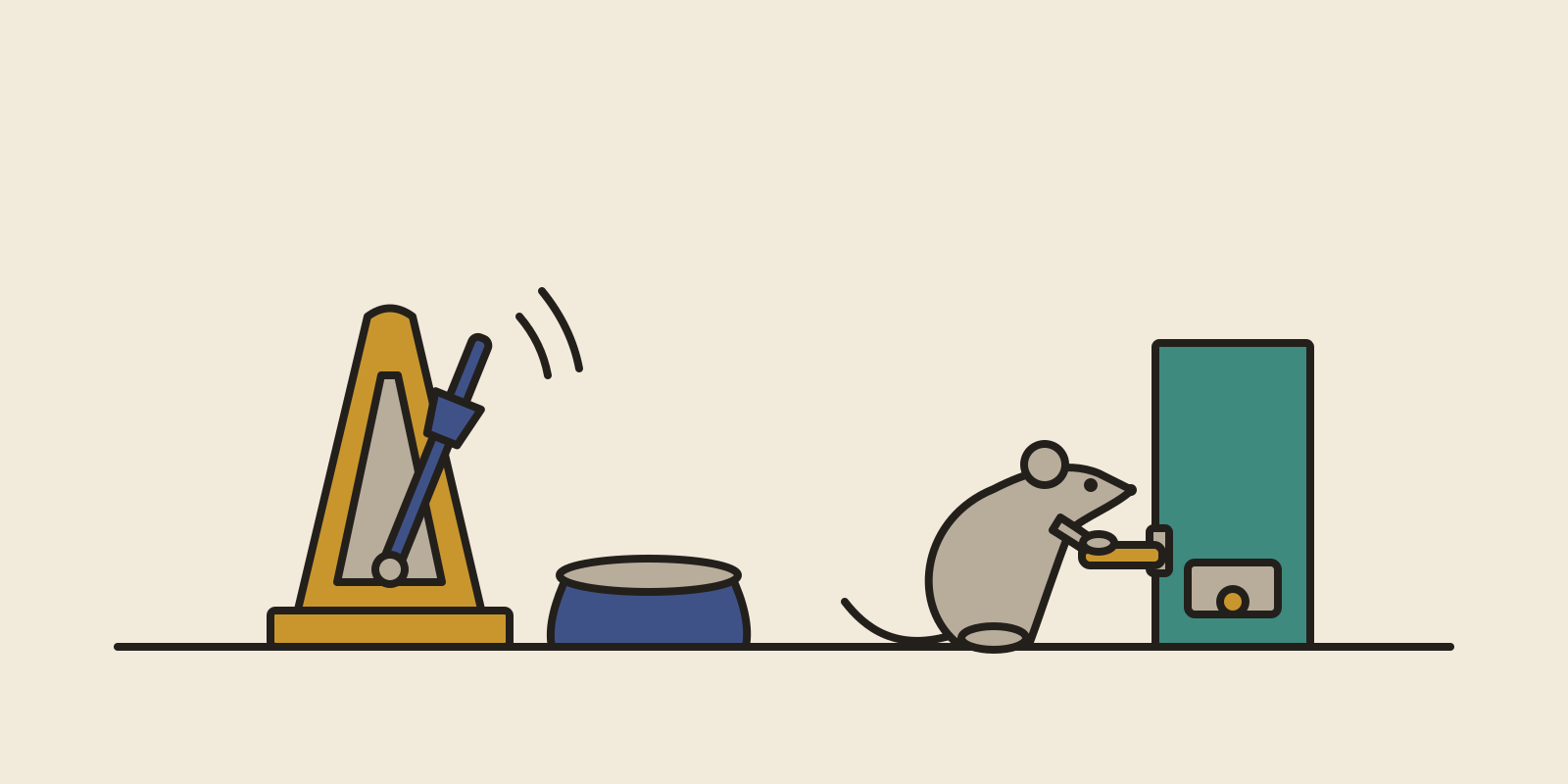
Comparison
| Classical conditioningPsychology | Operant conditioningPsychology | |
|---|---|---|
| Source | Ivan Pavlov, who described it in 1903 after meeting it in his work on digestion | B. F. Skinner, The Behavior of Organisms (1938), building on Edward Thorndike's law of effect |
| What gets linked | Two events: a signal and what follows it | An action and its consequence |
| The learner's part | None. The event follows the signal whatever the learner does | Essential. The outcome depends on what the learner does |
| Kind of response | Reflexes and emotional reactions, set off automatically | Actions that become more or less frequent |
| How it fades | The signal keeps arriving without the event | The action stops being followed by its payoff |
| Everyday sign | A child who was once badly stung tenses at any buzzing | A toddler who gets the biscuit for saying please says it more often |
Source
- Classical conditioning
- Ivan Pavlov, who described it in 1903 after meeting it in his work on digestion
- Operant conditioning
- B. F. Skinner, The Behavior of Organisms (1938), building on Edward Thorndike's law of effect
What gets linked
- Classical conditioning
- Two events: a signal and what follows it
- Operant conditioning
- An action and its consequence
The learner's part
- Classical conditioning
- None. The event follows the signal whatever the learner does
- Operant conditioning
- Essential. The outcome depends on what the learner does
Kind of response
- Classical conditioning
- Reflexes and emotional reactions, set off automatically
- Operant conditioning
- Actions that become more or less frequent
How it fades
- Classical conditioning
- The signal keeps arriving without the event
- Operant conditioning
- The action stops being followed by its payoff
Everyday sign
- Classical conditioning
- A child who was once badly stung tenses at any buzzing
- Operant conditioning
- A toddler who gets the biscuit for saying please says it more often
Diagram
The two kinds of conditioning differ in what the learner links
Read as text
Two panels divided by one dimension, what gets linked. The left panel, classical conditioning, lists signal with event, automatic response and learner need not act. The right panel, operant conditioning, lists action with consequence, action changes in frequency and outcome depends on learner.
Why people confuse them
They share a name, a laboratory tradition and a home in behavioural psychology. Both were worked out on laboratory animals, and both speak of extinction when learning fades. The word reinforcement adds to the confusion. Pavlov used it for following the signal with food, while its usual modern sense belongs to Skinner: a consequence that makes an action more frequent. Textbooks then teach the two in one chapter, with food as the prize in both stories.
Behavioural psychology (learning and behaviour analysis)
The branch of psychology that studies how behaviour is learned and changed, through experiments on animals and people and their practical use.
When the difference matters
Take two children who cause difficulty on family outings.
The first screams in the dentist's waiting room as soon as she hears the drill. Her parents promise a toy for sitting quietly and scold her when she cries, and neither works, because her fear was never an action that paid. It is a conditioned response: the sound has come to mean pain, and her body reacts before she decides anything. What helps is hearing the sound safely and repeatedly until it stops predicting harm.
Classical conditioning
Learning in which a signal that reliably comes before an event starts to trigger a response in advance of it.
The second screams at the supermarket checkout, and in the past screaming has produced sweets. Sitting him near the till until he calms down misses the point. His tantrum is operant behaviour, which lasts as long as it pays and weakens when the sweets stop coming.
Operant conditioning
Learning in which an action becomes more or less frequent because of the consequences that have followed it.
Swap the remedies and both children carry on as before.
Where they overlap
Both are forms of associative learning, and both are among the best established findings in psychology. Both also run into biological limits: rats link a taste with illness far more readily than with shock, and the Brelands' trained pigs slid back into instinctive rooting. In daily life the two usually arrive together: a dog taught to sit with treats learns that sitting pays, and it also comes to perk up at the rustle of the treat bag.
Further reading
- Pavlov, I. P. (1927). Conditioned reflexes: An investigation of the physiological activity of the cerebral cortex. Oxford University Press. (Original work published 1927)
- Rescorla, R. A. (1988). Pavlovian conditioning: It's not what you think it is. American Psychologist, 43(3), 151–160. https://doi.org/10.1037/0003-066X.43.3.151
- Skinner, B. F. (1938). The behavior of organisms: An experimental analysis. Appleton-Century.
- Staddon, J. E. R., & Cerutti, D. T. (2003). Operant conditioning. Annual Review of Psychology, 54, 115–144. https://doi.org/10.1146/annurev.psych.54.101601.145124
Cite this entry
Scholia. (2026). Classical conditioning vs operant conditioning. In Scholia: Notes in the margin of the human sciences. Retrieved November 28, 2026, from https://scholia.zennia.sg/versus/classical-conditioning-vs-operant-conditioning