VersusEconomics
Tragedy of the commons vs free-rider problem
Users of a commons take too much from a shared stock. Free riders give too little towards a shared benefit.
Comparison
| Tragedy of the commonsEconomics | Free-rider problemEconomics | |
|---|---|---|
| What goes wrong | Overuse: each user takes too much | Under-supply: each person gives too little |
| The good at stake | A stock open to all that can be used up, so what one takes is gone for the rest | A benefit that reaches everyone once it exists, whether or not they paid |
| Standard picture | Herders adding animals to a shared pasture | Neighbours asked to chip in to resurface a shared lane |
| Source | Garrett Hardin's essay of 1968, after Lloyd (1833) and Gordon (1954) | Mancur Olson's book of 1965, after Hume (1740) and Samuelson (1954) |
| Usual remedies | Private ownership or enforced limits. Ostrom added rules made by the users themselves | Taxes, private rewards kept for contributors, social pressure in small groups |
| Evidence | Mixed. Open-access resources often decline, managed commons often do not | The tendency is well supported, though strict free riding is rarer than theory implies |
What goes wrong
- Tragedy of the commons
- Overuse: each user takes too much
- Free-rider problem
- Under-supply: each person gives too little
The good at stake
- Tragedy of the commons
- A stock open to all that can be used up, so what one takes is gone for the rest
- Free-rider problem
- A benefit that reaches everyone once it exists, whether or not they paid
Standard picture
- Tragedy of the commons
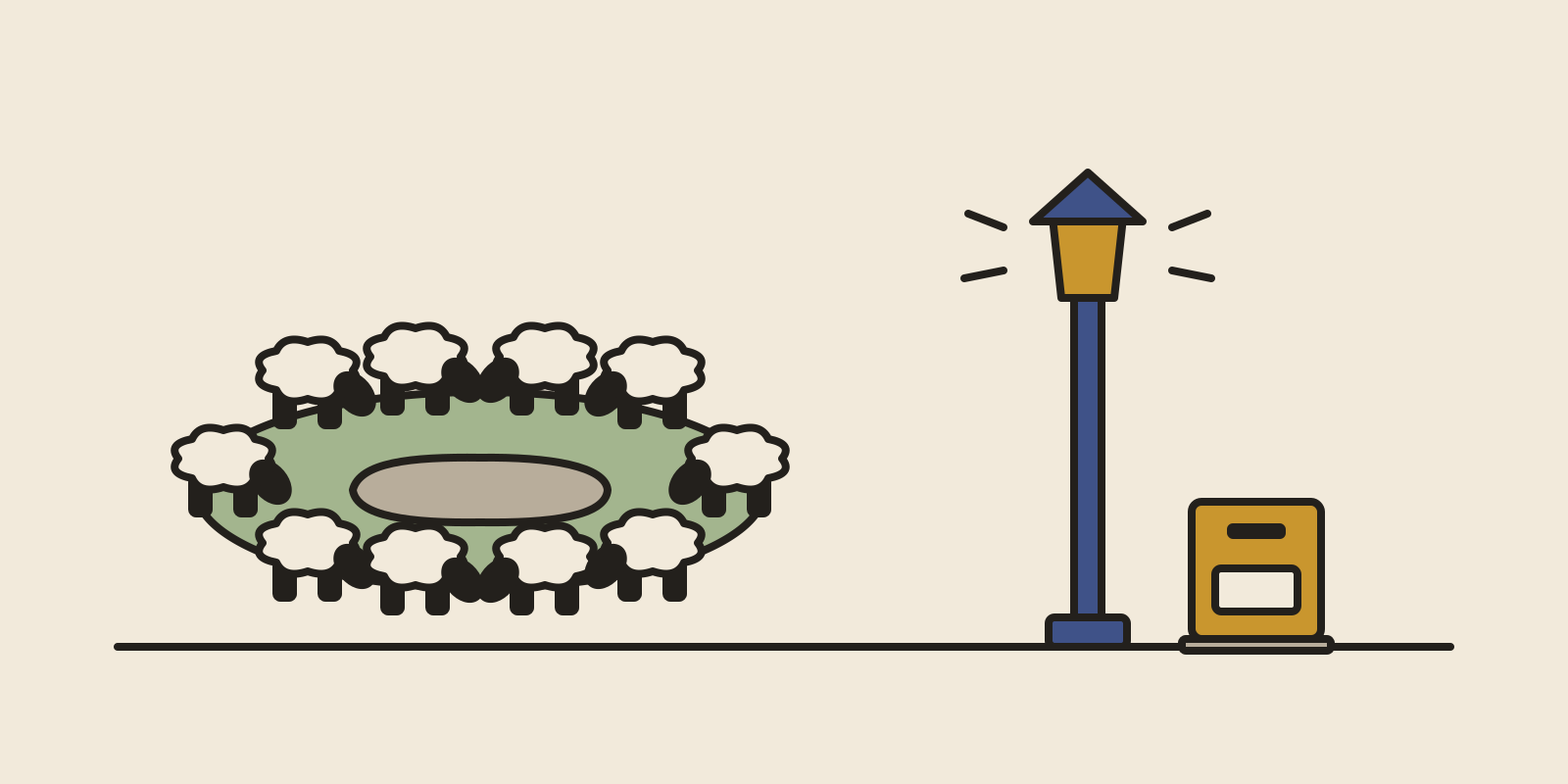
- Herders adding animals to a shared pasture
- Free-rider problem
- Neighbours asked to chip in to resurface a shared lane
Source
- Tragedy of the commons
- Garrett Hardin's essay of 1968, after Lloyd (1833) and Gordon (1954)
- Free-rider problem
- Mancur Olson's book of 1965, after Hume (1740) and Samuelson (1954)
Usual remedies
- Tragedy of the commons
- Private ownership or enforced limits. Ostrom added rules made by the users themselves
- Free-rider problem
- Taxes, private rewards kept for contributors, social pressure in small groups
Evidence
- Tragedy of the commons
- Mixed. Open-access resources often decline, managed commons often do not
- Free-rider problem
- The tendency is well supported, though strict free riding is rarer than theory implies
Diagram
One is taking too much, the other is giving too little
Read as text
Two overlapping circles. The left circle, the tragedy of the commons, holds users taking too much, a stock that can run out and limits on use as the remedy. The right circle, the free-rider problem, holds people giving too little, a benefit that reaches everyone and compulsory payment as the remedy. The shared centre holds sensible individual choices that add up to a poor result for the group.
Why people confuse them
The two share a skeleton. In each, people who act sensibly for themselves leave the group worse off, and no one has to be foolish or wicked. Both are often modelled as a prisoner's dilemma played by a crowd, and both get filed under collective action. Some cases fit both descriptions. Climate change is called a commons problem, because the atmosphere's capacity for carbon is being used up. It is also called a free-rider problem, because every country gains from the cuts that others make.
When the difference matters
An office kitchen can develop either problem, and the remedies are different.
In one office the milk is bought for everyone and runs out by Wednesday, because each person who pours a generous cup gets the whole benefit and bears a sliver of the cost. This is the tragedy of the commons in small. The cure is a limit on taking, such as a bottle each.
Tragedy of the commons
When a resource is open to all, each user gains by taking more, and together they can ruin it for everyone.
In another office the milk is paid for from a kitty that is always short, since half the staff drink the milk and never contribute. That is the free-rider problem, and the cure is a way of collecting: a fixed levy, or milk kept for those who paid.
Free-rider problem
When people can enjoy a benefit whether or not they pay for it, many will not pay and the benefit may never be supplied.
The wrong remedy changes nothing. Chasing contributions does not stop a fully funded fridge from emptying, and rationing cups does not fill a kitty.
Where they overlap
Both explain how a group can fail without anyone meaning harm, and both are standard arguments for binding rules, whether Hardin's agreed coercion or compulsory taxes. Both have also met the same surprise in the evidence. Elinor Ostrom documented commons that their users had managed for centuries, and Gerald Marwell and Ruth Ames found people in experiments contributing about half of what they could when theory predicted nothing.
Further reading
- Hardin, G. (1968). The tragedy of the commons. Science, 162(3859), 1243–1248. https://doi.org/10.1126/science.162.3859.1243
- Marwell, G., & Ames, R. E. (1981). Economists free ride, does anyone else? Experiments on the provision of public goods, IV. Journal of Public Economics, 15(3), 295–310. https://doi.org/10.1016/0047-2727(81)90013-X
- Olson, M. (1965). The logic of collective action: Public goods and the theory of groups. Harvard University Press. https://doi.org/10.4159/9780674041660
- Ostrom, E. (1990). Governing the commons: The evolution of institutions for collective action. Cambridge University Press. https://doi.org/10.1017/cbo9780511807763
Cite this entry
Scholia. (2026). Tragedy of the commons vs free-rider problem. In Scholia: Notes in the margin of the human sciences. Retrieved November 28, 2026, from https://scholia.zennia.sg/versus/tragedy-of-the-commons-vs-free-rider-problem
This topic is contested. The entry sets out the main positions rather than settling them.