IdeaPhilosophy
Argument from design
The argument from design holds that the order and apparent purpose in nature are best explained by an intelligent designer.
The idea
The argument from design holds that the order and apparent purpose found in nature are best explained by an intelligent designer. Parts of the natural world fit together to serve ends, as the parts of a machine do. Machines have makers. The argument concludes that nature has a maker too and that this maker is God. It is also called the teleological argument.
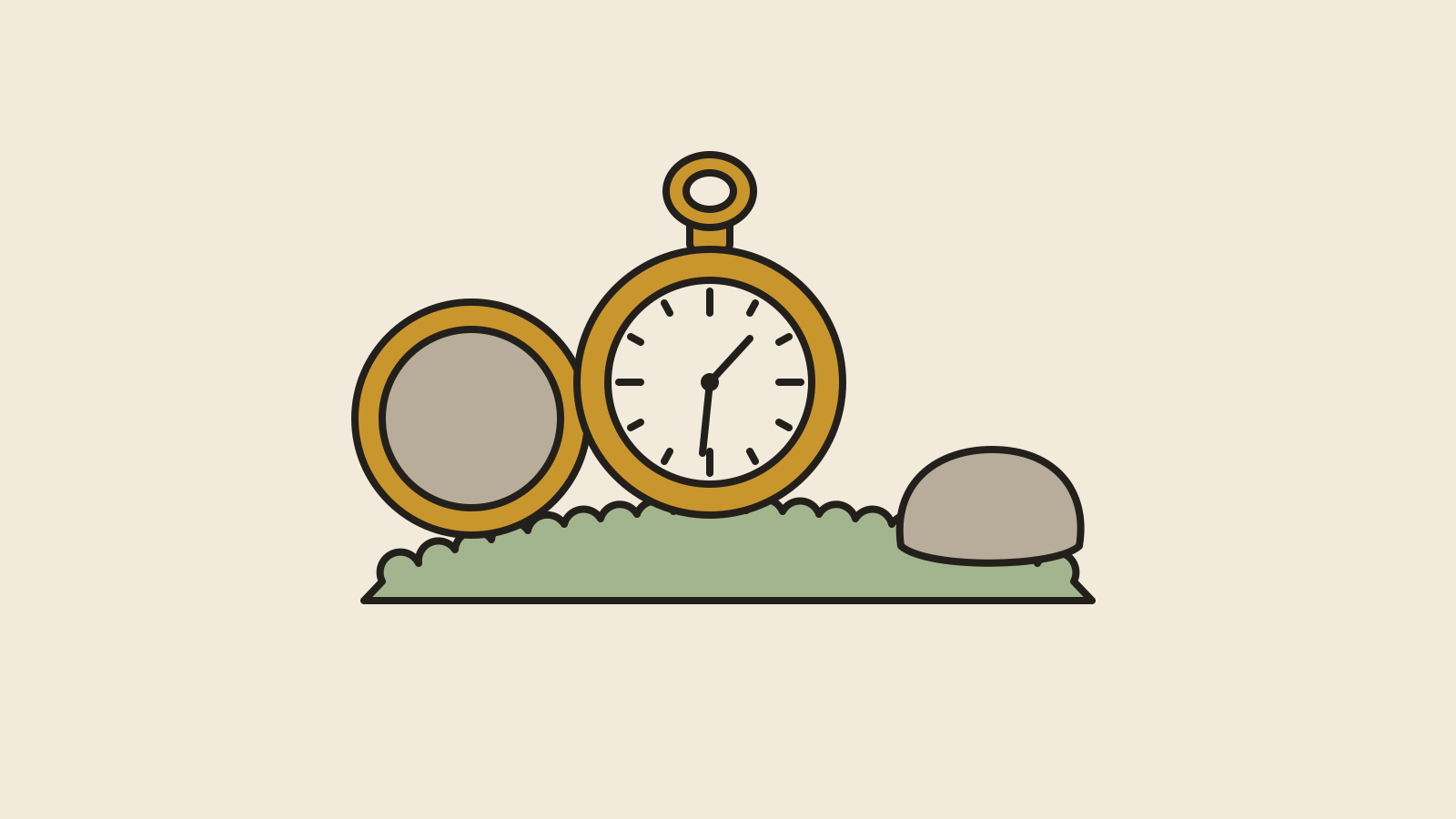
William Paley gave the best-known version in 1802. Suppose you find a watch lying on a heath. You would not suppose it had always been there, as you might of a stone. Its gears and spring are shaped and arranged to tell the time, and that arrangement points to a watchmaker. Paley then argued that an eye is fitted for seeing far more finely than a watch is fitted for timekeeping, so the same inference holds with greater force.
Diagram
Paley reasons from a watch to its maker, then from organisms to a designer
Read as text
Four steps in a row. First, the parts of a watch are arranged to serve a purpose. Second, we infer that a watch has a maker. Third, the parts of living things, such as the eye, serve purposes too. Fourth, Paley concludes by analogy that life has a designer. Hume denies that the analogy supports the fourth step, and Darwin offers natural selection as another explanation of the fit described in the third.
Key features
- It is an argument from evidence, offered as the best explanation of what we observe and not as a strict proof.
- Older versions reason by analogy between natural things and human artefacts.
- Biological versions point to the fit between organisms and their ways of life.
- Fine-tuning versions point to physical constants that permit life only within narrow ranges.
- By itself it supports a designer of some kind, and further argument is needed to reach the God of a particular faith.
Not to be confused with
| Look-alike | The difference | Differs on |
|---|---|---|
| Cosmological argument | The cosmological argument starts from the bare fact that a world exists. The design argument starts from specific features of this world, its order and fit. | Differs onScope |
| Teleology | Teleology is explanation by purpose and holds that natural things have ends. The design argument adds that those ends require a designing mind. Aristotle accepted the first claim without the second. | Differs onClaim |
| Ontological argument | The ontological argument uses no evidence. The design argument rests on observation, so science can weaken or strengthen it. | Differs onMethod |
| Natural selection | Darwin's rival explanation of the fit between organisms and their surroundings: inherited variation and unequal survival, with no foresight involved. | Differs onMechanism |
- Differs onScope
The cosmological argument starts from the bare fact that a world exists. The design argument starts from specific features of this world, its order and fit.
- Differs onClaim
Teleology is explanation by purpose and holds that natural things have ends. The design argument adds that those ends require a designing mind. Aristotle accepted the first claim without the second.
- Differs onMethod
The ontological argument uses no evidence. The design argument rests on observation, so science can weaken or strengthen it.
- Differs onMechanism
Natural selection
Darwin's rival explanation of the fit between organisms and their surroundings: inherited variation and unequal survival, with no foresight involved.
Origins and development
The argument is ancient. Xenophon's Socrates and the Stoics used it, and Thomas Aquinas made it the last of his Five Ways. The mechanical science of the seventeenth century gave it new life, and Paley's Natural Theology was its fullest statement. Darwin, who had admired Paley as a student, published a natural explanation of biological adaptation in 1859. In recent decades attention has shifted to the fine-tuning of physical constants, and the intelligent design movement revived a biological form in the 1990s.
Stoicism
An ancient school teaching that good character is the only true good, and that distress comes from our judgements about events, which we can change.
Thomas Aquinas
The Dominican friar who joined Aristotle's philosophy to Christian theology and gave natural law and the arguments for God their classic form.
Why it matters
Even Kant, who rejected it, called it the oldest and clearest of the proofs. It begins with wonder at the natural world and needs no technical premises. It sits where religion and science meet, so it surfaces in arguments over evolution, over what physics can explain and over what belongs in a science lesson.
Immanuel Kant
A Prussian philosopher who argued that the mind shapes the world we experience and that morality is a law reason gives itself.
Critiques and limits
David Hume argued before Paley wrote that the analogy is weak, that a designer would itself need explaining and that a flawed world suggests a flawed maker. Darwin supplied an alternative for living things, and biologists such as Richard Dawkins hold that it removes the biological argument. Defenders such as Richard Swinburne reply that fine-tuning is untouched by Darwin, and critics answer that there may be many universes. The evidence is contested: the biological form has lost nearly all scientific support, and the cosmic form is in live dispute.
David Hume
A Scottish philosopher who argued that our beliefs about causes, the self and morality rest on habit and feeling more than on reason.
In education and policy
In Kitzmiller v. Dover (2005) a United States federal court ruled that teaching intelligent design in the science classes of publicly funded schools was unconstitutional, finding it a religious view and not science. Supporters of intelligent design say this shuts a legitimate question out of the classroom. Most scientific bodies and science educators say the design argument belongs in philosophy or religious studies lessons, where it is a standard topic, for example at A level in England.
Connections
Belongs to
It is one of the three classic arguments for God's existence that the field examines.
Influenced by
The Stoics argued that the world's order shows a governing intelligence, the form Cicero recorded and later writers inherited.
His Fifth Way argues that things without knowledge act for ends, so an intelligence must direct them.
Aristotle supplied the premise that natural things act for ends, though he saw no need for a designing mind behind them.
Xenophon's Socrates argues from the fit of eyes, eyelids and senses to a craftsman god, an early version the Stoics developed.
Critiques
Design arguments from the Stoics onward were aimed at the Epicurean claim that order arose from atoms colliding by chance.
Contrasts with
Differs on scope. The cosmological argument starts from the existence of any world, where the design argument starts from this world's order.
Differs on claim. Teleology says natural things have ends, and the design argument adds that such ends require a designer.
Differs on method. The design argument infers a designer from observed order, where the ontological argument uses no evidence at all.
Differs on claim. Design argues from the world's order to a designer, where evil argues from its suffering against a good one.
Critiqued by
His Dialogues argue that the analogy between the world and a machine is too weak to prove a designer.
Lucretius argued that a world so full of faults cannot have been made for us by gods.
Spontaneous orderEconomics
Hayek rejects for society the inference the design argument makes for nature: that order implies a designing mind.
Cross with
Two distant entries to read beside this one, each with the question the pairing opens.
Gestalt principles of perceptionPsychology
Vision groups scattered elements into whole figures by its own rules: how much of the order we find in nature does the perceiver supply? Set them side by side
Functionalism (anthropology)Anthropology
Functionalists explained each custom by the job it does: what separates explaining by function from inferring that someone designed the thing for that job? Set them side by side
Further reading
- Dawkins, R. (1986). The blind watchmaker: Why the evidence of evolution reveals a universe without design. W. W. Norton.
- Hume, D. (2007). Dialogues concerning natural religion and other writings. Cambridge University Press. (Original work published 1779)
- Paley, W. (2006). Natural theology: Or, evidence of the existence and attributes of the Deity, collected from the appearances of nature. Oxford University Press. (Original work published 1802)
Cite this entry
Scholia. (2026). Argument from design. In Scholia: Notes in the margin of the human sciences. Retrieved November 28, 2026, from https://scholia.zennia.sg/ideas/argument-from-design
This topic is contested. The entry sets out the main positions rather than settling them.