IdeaPolitical theory & scienceAlso in Philosophy, Economics
Justice as fairness
Rawls's theory that a just society secures equal basic liberties and permits inequalities only when they benefit the least advantaged.
The idea
Justice as fairness is John Rawls's answer to a question every society settles one way or another: how should its main institutions share out rights, opportunities and wealth? His test is agreement. Fair terms are the ones free and equal people would accept if none could rig the choice in their own favour, which is the job of the veil of ignorance.
Veil of ignorance
A thought experiment: choose the rules of society without knowing who you will be in it, and the rules will be fair.
Rawls argued that two principles would be chosen. First, everyone gets the same full set of basic liberties. Second, inequalities of income and position are allowed only if the jobs that carry them are open to all under fair equality of opportunity, and only if they leave the poorest better off than any alternative would.
Surgeons' pay is a stock example. If high salaries draw able people into long training and the result is better care for everyone, the poorest patients included, the inequality passes. If the same pay merely reflects a closed profession, it fails.
Diagram
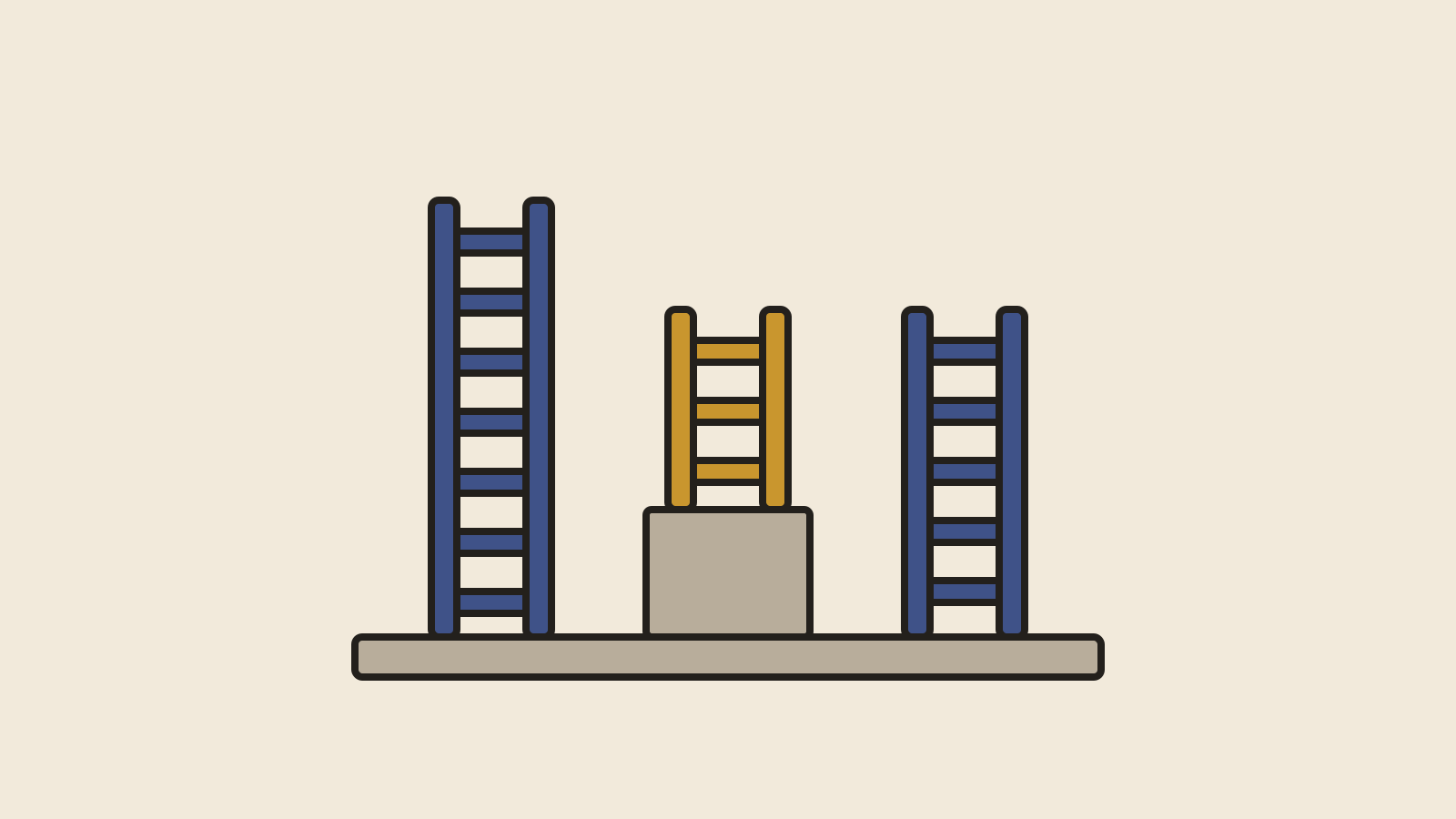
Rawls's principles are ranked, and a higher one is never traded for a lower
Read as text
A stack of three principles in order of priority. At the top are the equal basic liberties, such as freedom of conscience, speech and the vote. Second is fair equality of opportunity: positions must be open to all on fair terms. Third is the difference principle: remaining inequalities must work to the greatest benefit of the least advantaged. The ordering principle is lexical priority, which means a higher principle must be satisfied before a lower one applies, so liberty is never given up for economic gain.
Key features
- It applies to the basic structure, meaning a society's constitution, economy and main institutions, and leaves most private choices alone.
- The principles are ranked: liberty may not be traded for wealth, and fair opportunity comes before the difference principle.
- Advantage is measured in primary goods, the all-purpose means such as rights, opportunities, income and the social bases of self-respect.
- Natural talent and family background are treated as morally arbitrary, so nobody deserves the larger share their luck brings.
- The theory is a form of social contract, with a hypothetical agreement standing in for a historical one.
Social contract
Political authority is legitimate only if the people who live under it have agreed, or would agree, to be governed.
Not to be confused with
| Look-alike | The difference | Differs on |
|---|---|---|
| Veil of ignorance | The veil is the device used to argue for the theory. Justice as fairness is the whole theory, including the two principles the device is meant to yield. | Differs onScope |
| Equality of outcome | Rawls does not require equal incomes. Unequal rewards are just when they raise the position of the worst off and unjust when they do not. | Differs onClaim |
| Entitlement theory | Robert Nozick held that a distribution is just if it arose from fair acquisition and free transfers, whatever it looks like. Rawls judges the pattern that institutions produce. | Differs onClaim |
| Capability approach | Rawls compares people by the primary goods they hold. Amartya Sen compares what they can do and be with those goods, since a disabled person may need more income for the same life. | Differs onStandard of judgement |
- Differs onScope
The veil is the device used to argue for the theory. Justice as fairness is the whole theory, including the two principles the device is meant to yield.
- Differs onClaim
Equality of outcome
Rawls does not require equal incomes. Unequal rewards are just when they raise the position of the worst off and unjust when they do not.
- Differs onClaim
Entitlement theory
Robert Nozick held that a distribution is just if it arose from fair acquisition and free transfers, whatever it looks like. Rawls judges the pattern that institutions produce.
- Differs onStandard of judgement
Rawls compares people by the primary goods they hold. Amartya Sen compares what they can do and be with those goods, since a disabled person may need more income for the same life.
Origins and development
Rawls first used the phrase as the title of a short paper in 1957, enlarged it in 1958 and developed it through the 1960s into A Theory of Justice (1971). The book answered utilitarianism, then dominant, with a rival built on the contract tradition of Locke, Rousseau and Kant. In Political Liberalism (1993) he recast the theory as a political conception that citizens of different faiths and philosophies could share. Justice as Fairness: A Restatement (2001) gave his final version. Economists adopted the difference principle as the maximin rule for ranking policies.
Utilitarianism
The moral theory that the right act is the one producing the greatest total well-being, with everyone's interests counted equally.
Why it matters
The theory supplies a standard argument for progressive taxation, public education and a social minimum: fair terms of cooperation require them, so they are owed and are no act of charity. Asking how a budget or a reform treats the worst-off group is a Rawlsian habit, now common among people who have never read him. Its priority of liberty matches the way constitutional courts treat basic rights as more than one interest to be weighed against prosperity.
Critiques and limits
Nozick objected that any favoured pattern is upset the moment people trade freely, so keeping it means constant interference. John Harsanyi argued that rational choosers would maximise average welfare, which leads back to utilitarianism. Sen charged that the theory describes a perfectly just society and gives little help in comparing imperfect ones. G. A. Cohen held that talented people who demand incentives are not acting on the principle they claim to accept. The theory is a normative argument. Reasoning and considered judgement test it, and no experiment can.
Connections
Belongs to
It is the leading egalitarian statement of liberalism, ranking basic liberties above economic gains.
The theory reset the field's agenda, so that later accounts of justice are framed as replies to it.
Originated by
Rawls named the theory in papers of 1957 and 1958 and gave it full form in A Theory of Justice in 1971.
Extends
Recasts the contract as a hypothetical choice of principles for a society's basic institutions.
Critiques
UtilitarianismPhilosophy
Rejects summing welfare across persons, since a larger total can be bought with a few people's liberty or prospects.
Contrasts with
Capability approachEconomics
Differs on standard of judgement. Rawls compares people by the primary goods they hold, Sen by what those goods let them do and be.
Differs on scope. The veil is the device of argument, and justice as fairness is the whole theory it is meant to yield.
Parallels
Davis–Moore thesisSociology
Both defend some inequality by the incentives it gives the talented. Davis and Moore state it as fact, Rawls as a condition.
Applied in
Public and welfare economicsEconomics
Economists turned the difference principle into the maximin welfare function, which ranks policies by the worst-off position.
Influenced
Stages of moral developmentPsychology
Kohlberg used Rawls's choice of rules from behind a veil as his model of the most mature moral reasoning.
Critiqued by
Amartya SenEconomics
Sen argued that equal primary goods leave people unequal, because people differ in what they can do with the same goods.
Nozick argued that keeping Rawls's pattern of distribution in place requires continual interference with voluntary exchange.
Cross with
Two distant entries to read beside this one, each with the question the pairing opens.
HeritabilityPsychology
Rawls treats inborn talent as undeserved luck. What follows for his difference principle if much of the variation in ability is heritable? Set them side by side
Gini coefficientEconomics
The Gini coefficient scores a society by how unequal it is. What single number would Rawls track instead to judge whether it is just? Set them side by side
Further reading
- Nozick, R. (1974). Anarchy, state, and utopia. Basic Books.
- Rawls, J. (1971). A theory of justice. Harvard University Press. https://doi.org/10.4159/9780674042605
- Rawls, J. (2001). Justice as fairness: A restatement. Harvard University Press. https://doi.org/10.2307/j.ctv31xf5v0
- Sen, A. (2009). The idea of justice. Harvard University Press. https://doi.org/10.4159/9780674054578
Cite this entry
Scholia. (2026). Justice as fairness. In Scholia: Notes in the margin of the human sciences. Retrieved November 28, 2026, from https://scholia.zennia.sg/ideas/justice-as-fairness
This topic is contested. The entry sets out the main positions rather than settling them.