IdeaCognitive science & linguistics
Markedness
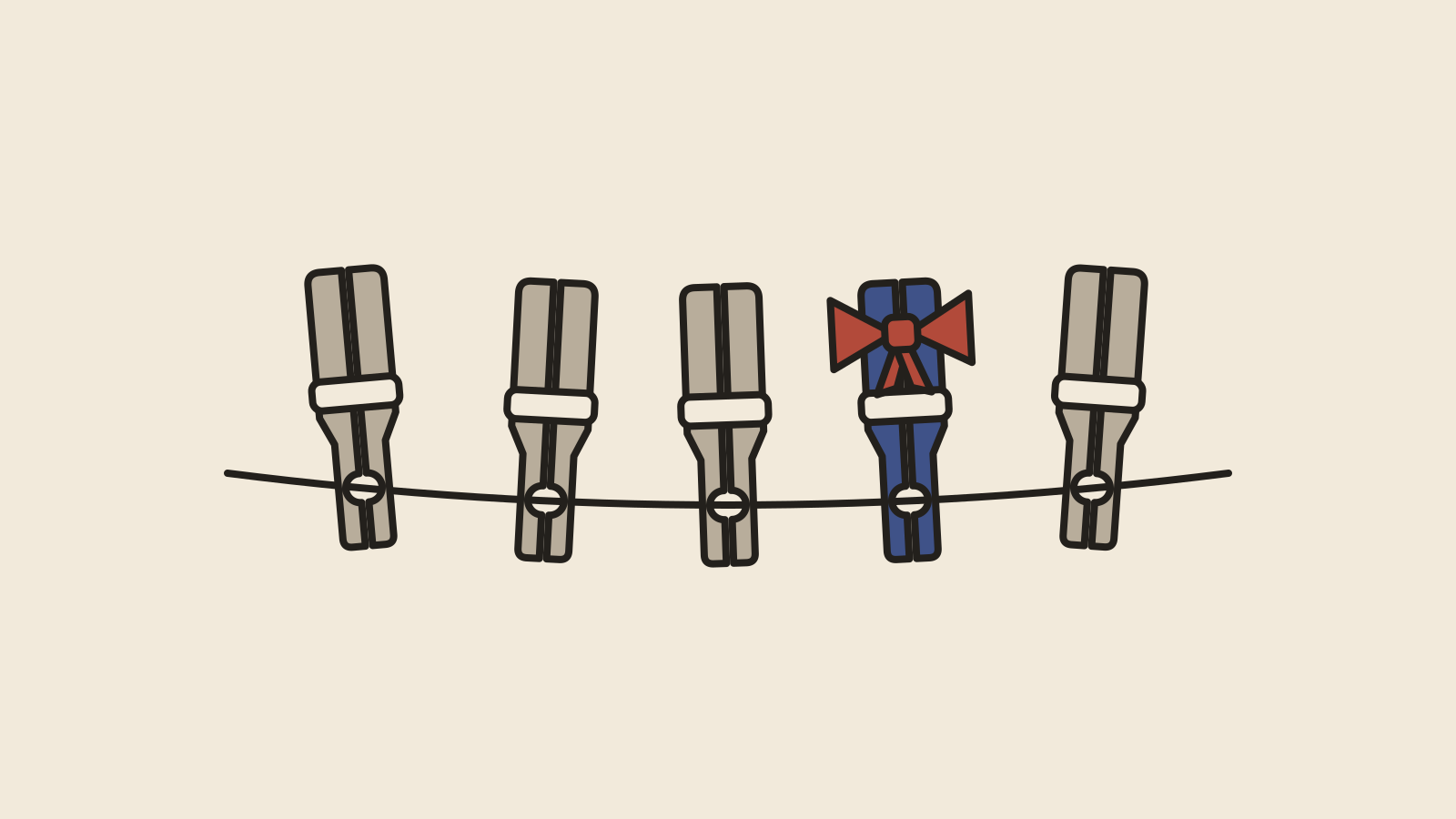
In a pair of contrasting forms, one is the plain default and the other carries an extra mark, and the two behave unequally.
The idea
Many contrasts in language are lopsided. One member of the pair is the ordinary, expected form, while the other is the special case and usually shows this by carrying something extra. Linguists call the first unmarked and the second marked.
English has plenty of examples. We ask "How old is the baby?" and "How tall is that wall?", even of a newborn or a low wall. "How young?" or "How short?" would assume an answer in advance. Old and tall are unmarked, since they can stand for the whole scale. In the same way "book" is unmarked beside "books", which adds an ending, and "happy" beside "unhappy".
Markedness theory claims that such asymmetries are no accident. The unmarked form tends to be shorter, commoner and learned earlier. It also survives where the contrast is suspended, and similar asymmetries turn up in language after language.
Diagram
In a lopsided contrast one member is the default and the other carries a mark
Read as text
A contrast divided into two sides by the role each member plays. On the left is the unmarked member: the plain default form, more frequent, able to cover the whole pair. On the right is the marked member: it carries an extra feature, is less frequent and has a narrower use.
Key features
- The marked member carries an extra feature, in sound or in meaning, that the unmarked member lacks.
- The unmarked member has the wider use and can stand for the pair as a whole, as "lion" can cover lionesses.
- Where a contrast is suspended, the unmarked form normally appears, as at the end of German words, where d is pronounced t.
- Marked forms tend to be rarer in speech, later in children's learning and absent from more of the world's languages.
- Meaning and form tend to line up, so that the more specific meaning gets the longer or heavier form.
Not to be confused with
| Look-alike | The difference | Differs on |
|---|---|---|
| Prototype theory | Prototype theory ranks the many members of one category by how typical they are, robin above penguin. Markedness sets two opposed categories against each other, such as singular and plural, and says one is the default. | Differs onUnit of analysis |
| Arbitrariness of the sign | Saussure's principle says the bond between a word's form and its meaning rests on convention alone. Markedness finds a pattern in grammar where extra meaning tends to receive extra form, which Jakobson used as evidence against him. | Differs onClaim |
| Phoneme | A phoneme is a unit, one of the sounds that tell words apart. Markedness is a relation between two such units, or two grammatical forms, in which one is basic. | Differs onLevel |
| Frequency | Unmarked forms are usually the commoner ones, and the theory treats that as a symptom of a deeper asymmetry in the system. Critics hold that frequency itself is the cause. | Differs onMechanism |
- Differs onUnit of analysis
Prototype theory ranks the many members of one category by how typical they are, robin above penguin. Markedness sets two opposed categories against each other, such as singular and plural, and says one is the default.
- Differs onClaim
Saussure's principle says the bond between a word's form and its meaning rests on convention alone. Markedness finds a pattern in grammar where extra meaning tends to receive extra form, which Jakobson used as evidence against him.
- Differs onLevel
A phoneme is a unit, one of the sounds that tell words apart. Markedness is a relation between two such units, or two grammatical forms, in which one is basic.
- Differs onMechanism
Frequency
Unmarked forms are usually the commoner ones, and the theory treats that as a symptom of a deeper asymmetry in the system. Critics hold that frequency itself is the cause.
Origins and development
Nikolai Trubetzkoy proposed the idea in a letter to Roman Jakobson in 1930, to describe sound contrasts such as voiced against voiceless consonants. Both belonged to the Prague Linguistic Circle. Jakobson answered that the notion reached far beyond phonology, and in 1932 he applied it to the grammatical categories of the Russian verb. Joseph Greenberg's survey of 1966 tied markedness to patterns across the world's languages. Noam Chomsky and Morris Halle built it into generative phonology in 1968. Optimality theory, from 1993, gave half its machinery to markedness constraints.
Roman Jakobson
Russian-born linguist who carried structuralism from Moscow to Prague to America and showed that speech sounds are built from a few two-way contrasts.
Noam Chomsky
American linguist who argued that the capacity for grammar is inborn, and one of the best-known critics of United States foreign policy.
Why it matters
The idea travels beyond grammar. Job titles show it when "nurse" attracts "male" and "doctor" attracts "woman", and debates over generic "he" turn on which gender a language treats as unmarked. Language teachers use it to predict which sounds and structures learners will find hard. Linguists who compare languages use it to explain why some patterns are common across the world and others rare.
Critiques and limits
Martin Haspelmath argued in 2006 that linguists use the word in a dozen different senses, including "harder to pronounce", "less frequent" and simply "unusual". Most of what it explains, he said, follows from frequency of use: common forms get shortened and serve as defaults. Joan Bybee makes a similar case. Defenders such as Edwin Battistella reply that the asymmetries cluster too consistently to be separate accidents. The individual patterns are well documented, but whether a single principle underlies them is contested.
Connections
Belongs to
It came out of the Prague School's analysis of sounds into two-way oppositions.
Originated by
Jakobson took up Trubetzkoy's 1930 proposal about sound contrasts and extended it to grammar and meaning.
Contrasts with
Differs on unit of analysis. Prototype theory ranks the members of one category by typicality, while markedness sets two opposed categories against each other.
Differs on claim. Arbitrariness says the tie between form and meaning rests on convention alone, while markedness finds that extra meaning tends to get extra form.
Differs on level. A phoneme is one unit of the sound system, while markedness is an unequal relation between two units.
Applied in
Chomsky and Halle's 1968 phonology used markedness to rate sound systems as more or less natural.
Sociology of genderSociology
Students of gender use it to show how the male form of a word passes as the neutral one.
Researchers use it to predict which sounds and structures children and adult learners will master late.
Further reading
- Battistella, E. L. (1990). Markedness: The evaluative superstructure of language. State University of New York Press.
- Greenberg, J. H. (1966). Language universals: With special reference to feature hierarchies. Mouton.
- Haspelmath, M. (2006). Against markedness (and what to replace it with). Journal of Linguistics, 42(1), 25–70. https://doi.org/10.1017/S0022226705003683
- Trubetzkoy, N. S. (1969). Principles of phonology. University of California Press. (Original work published 1939)
Cite this entry
Scholia. (2026). Markedness. In Scholia: Notes in the margin of the human sciences. Retrieved November 28, 2026, from https://scholia.zennia.sg/ideas/markedness