IdeaPsychologyAlso in Philosophy, Anthropology, Cognitive science & linguistics
Nature and nurture
The long argument over how far people are shaped by what they inherit and how far by what happens to them.
The idea
People differ in height, temperament and talent. Nature and nurture names the two broad kinds of explanation. Nature is what a person inherits, today understood as their genes. Nurture is everything that happens to them, from conditions in the womb to diet, family, schooling and luck.
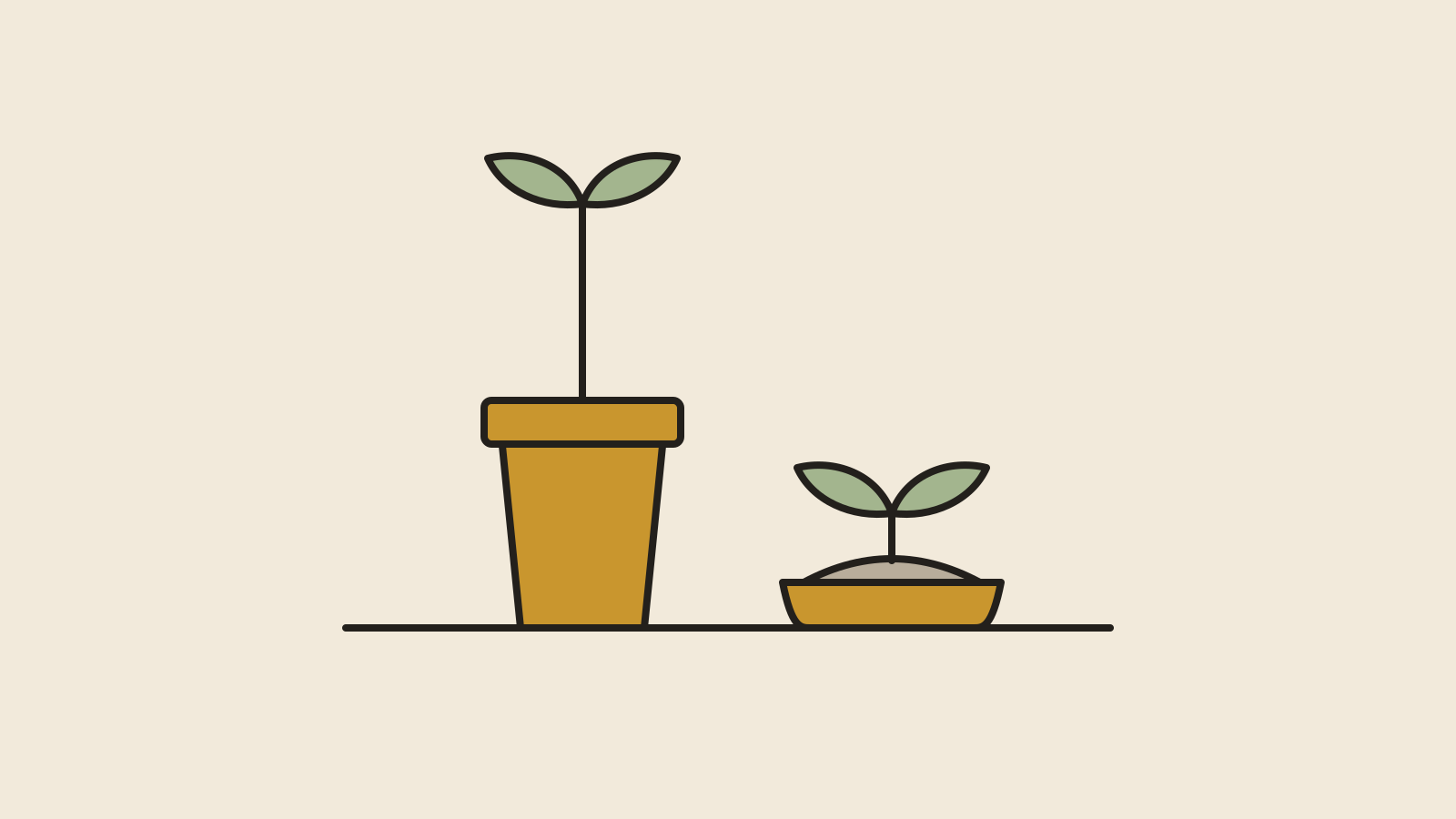
Height shows why the two can't be pulled apart. Tall parents tend to have tall children, and twin studies put most of the variation in height within a well-fed population down to genes. Yet average height in many countries rose by several centimetres over the twentieth century as food and health improved, far too quickly for genes to have changed. Both statements are true at once.
Hardly any researcher now defends either pole. The working view is that every trait needs both, and that genes and environments act through each other. The live disputes are about how much of the variation in a given trait each accounts for, and what follows from the numbers.
Diagram
Every trait is the joint product of inheritance and experience
Read as text
Two factors meet to produce one outcome. Nature is the genes a person inherits: many variants, each with a small effect. Nurture is everything that happens to the person, including conditions in the womb, diet, family, schooling and chance events. The two interact, and the developed trait is their joint product, so neither can be given sole credit.
Key features
- Twin and adoption studies compare relatives who share genes, homes or both, to estimate how much of the variation in a trait goes with each.
- Nearly every psychological trait that has been measured shows some genetic influence, personality and school attainment included, and none is fully fixed by genes.
- Genes and environment interact: the same upbringing affects different children differently, and the same genes lead to different outcomes in different settings.
- People also choose and shape their surroundings, partly in line with inherited leanings, so the two sources are correlated.
Not to be confused with
| Look-alike | The difference | Differs on |
|---|---|---|
| Heritability | Heritability is one statistic used within the debate: the share of the variation in a trait, in a given population, that goes with genetic differences. It says nothing about how far genes fix the trait in any one person. | Differs onScope |
| Tabula rasa | The blank slate is one position in the debate, the pole that credits almost everything to experience. Nature and nurture is the whole field of argument. | Differs onScope |
| Goodness of human nature (xing shan) | Mencius claimed a moral starting point that all people share. The nature and nurture debate asks what explains the differences between them. | Differs onScope |
| Genetic determinism | The view that genes fix outcomes whatever the environment. Finding a genetic influence on a trait doesn't imply it. A strongly inherited condition can still be changed, as spectacles correct short sight. | Differs onClaim |
- Differs onScope
Heritability is one statistic used within the debate: the share of the variation in a trait, in a given population, that goes with genetic differences. It says nothing about how far genes fix the trait in any one person.
- Differs onScope
The blank slate is one position in the debate, the pole that credits almost everything to experience. Nature and nurture is the whole field of argument.
- Differs onScope
Goodness of human nature (xing shan)
Mencius claimed a moral starting point that all people share. The nature and nurture debate asks what explains the differences between them.
- Differs onClaim
Genetic determinism
The view that genes fix outcomes whatever the environment. Finding a genetic influence on a trait doesn't imply it. A strongly inherited condition can still be changed, as spectacles correct short sight.
Origins and development
The pairing of the words is old. Shakespeare used it in The Tempest, and the Elizabethan schoolmaster Richard Mulcaster before him. Francis Galton made it a research question in 1874 and proposed a year later that twins could be studied to separate the two. He took heredity's side and went on to found eugenics. Behaviourists such as John B. Watson swung opinion towards environment between the wars. Twin and adoption studies from the 1960s swung it back. Genome studies since about 2005 have found that most traits are influenced by thousands of genetic variants, each of tiny effect.
John B. Watson
American psychologist who founded behaviourism in 1913, arguing that psychology should study what people do and drop the inner life.
Why it matters
The question sits under arguments about schooling, crime, mental illness, sex differences and inequality. If a difference is thought to be inborn, people tend to conclude that little can be done. If it is thought to be learned, they look for someone to blame. Neither inference is safe. The debate also carries a history: claims about inherited ability were used to justify forced sterilisation and immigration bars in the early twentieth century.
Critiques and limits
Behaviour geneticists such as Robert Plomin read the twin evidence as showing that inherited differences are the main systematic source of differences in ability and personality. Richard Lewontin argued in 1974 that such estimates can't divide causes that interact, and Eric Turkheimer adds that they shift with social conditions. Reported interactions between single genes and upbringing have often failed to replicate. That both sources matter is well supported. Their weights for particular traits, and the meaning of differences between groups, remain disputed.
Connections
Belongs to
How inherited potential and experience combine as a child grows is the branch's organising question.
Personality and individual differences
The branch's twin and adoption studies are the main source of evidence on why people differ.
Contrasts with
Goodness of human nature (xing shan)Philosophy
Differs on scope. Nature and nurture asks what explains differences between people, where Mencius claims a moral starting point all people share.
Differs on scope. Nature and nurture is the broad question of what shapes people, and heritability is one statistic bearing on it.
Tabula rasaPhilosophy
Differs on scope. Tabula rasa is one position within the nature and nurture debate, the pole that credits almost everything to environment.
Structure and agencySociology
Differs on scope. Nature and nurture asks where a person's traits come from, where this asks how far the formed person shapes events.
Parallels
Both replace an either-or question about causes with an account of how several kinds of cause work together.
Applied in
Language acquisitionCognitive science & linguistics
Whether grammar is inborn or learned from speech heard in childhood is the debate's best-known case outside psychology.
Cross with
Two distant entries to read beside this one, each with the question the pairing opens.
Social mobilitySociology
How much of the likeness between parents' and children's rank is inherited ability, and how much inherited circumstance? Set them side by side
Doing genderSociology
If gender is something people do in everyday dealings and are held to account for, what is left for inheritance to explain? Set them side by side
Further reading
- Galton, F. (1874). English men of science: Their nature and nurture. Macmillan. https://doi.org/10.5962/bhl.title.26466
- Polderman, T. J. C., Benyamin, B., de Leeuw, C. A., Sullivan, P. F., van Bochoven, A., Visscher, P. M., & Posthuma, D. (2015). Meta-analysis of the heritability of human traits based on fifty years of twin studies. Nature Genetics, 47(7), 702–709. https://doi.org/10.1038/ng.3285
- Ridley, M. (2003). Nature via nurture: Genes, experience, and what makes us human. HarperCollins.
- Turkheimer, E. (2000). Three laws of behavior genetics and what they mean. Current Directions in Psychological Science, 9(5), 160–164. https://doi.org/10.1111/1467-8721.00084
Cite this entry
Scholia. (2026). Nature and nurture. In Scholia: Notes in the margin of the human sciences. Retrieved November 28, 2026, from https://scholia.zennia.sg/ideas/nature-and-nurture
This topic is contested. The entry sets out the main positions rather than settling them.