IdeaCognitive science & linguisticsAlso in Philosophy
Turing machine
An imaginary machine that reads and writes symbols on a tape by fixed rules, which defines what it means to compute anything.
The idea
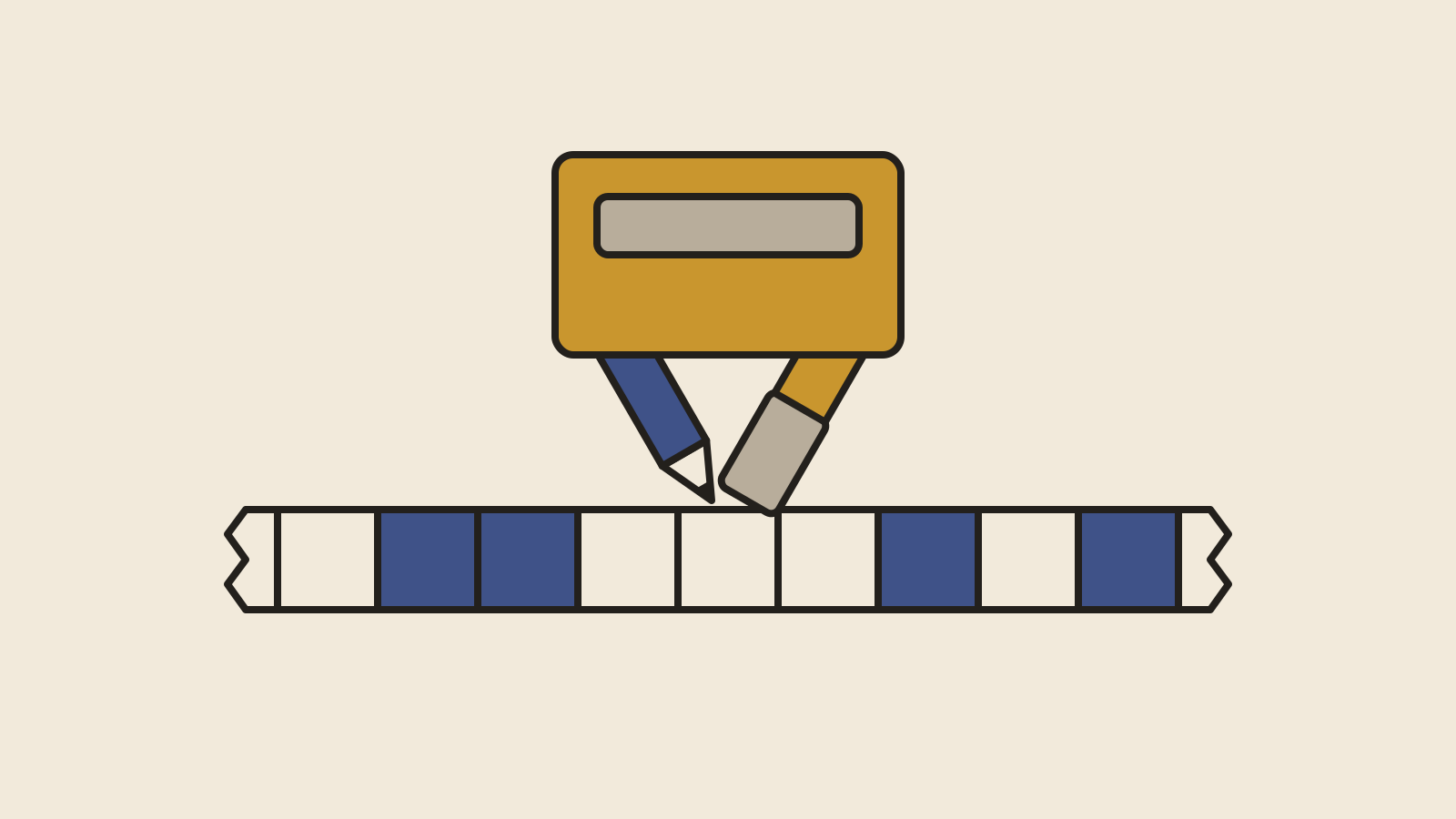
A Turing machine is an imaginary device, described by Alan Turing in 1936, that pins down what it means to work something out by following rules. It has a paper tape divided into squares, a head that looks at one square at a time and a table of instructions. At each step the machine reads the symbol under the head. The table then says what to write there, whether to move one square left or right and which instruction to follow next.
Think of a pupil doing long multiplication in a squared exercise book. They look at a digit or two, write one down, shift their attention a square along and remember only where they are in the method. Turing argued that any calculation a person can do by rule comes down to steps like these, so a machine of this kind can do it too. The claim that nothing computable escapes such machines is called the Church–Turing thesis.
Diagram
A Turing machine repeats one small step until no rule applies
Read as text
A flow of five steps that loops. The machine reads the symbol on the square under its head. It looks up the rule for that symbol in its present state. It writes a symbol on the square. It moves one square left or right. It enters the next state named by the rule, then returns to the first step and reads again. In the usual modern account the machine stops when its table has no rule for what it reads.
Key features
- Finite rules, unlimited tape: the table of instructions is fixed, while the tape supplies as much working space as the task needs.
- One local step at a time: the machine sees a single square and changes a single symbol, so no step calls for insight.
- Universality: one machine can imitate any other whose table is written on its tape, which is the idea of a program.
- Built-in limits: Turing proved that no machine can tell in general how another machine's computation will turn out, a result later retold as the halting problem.
- A mathematical yardstick: it is a tool for reasoning about what can be computed, and nobody builds working computers this way.
Not to be confused with
| Look-alike | The difference | Differs on |
|---|---|---|
| Turing test | The machine is Turing's 1936 mathematical model of what can be computed. The test is his 1950 proposal for judging whether a machine thinks, by whether it can pass for a person in written conversation. | Differs onClaim |
| Computational theory of mind | The Turing machine defines computation and says nothing about brains. The computational theory borrows the definition and adds a claim about people: human thinking is computation of this kind. | Differs onClaim |
| Physical symbol system hypothesis | Turing's analysis says which functions can be computed at all. Newell and Simon's hypothesis claims that computing with symbols is enough to produce general intelligence, which the mathematics does not say. | Differs onClaim |
| Von Neumann architecture | The Turing machine is an abstract model with an endless tape and no concern for speed. The von Neumann architecture is the practical layout of processor and stored memory inside most real computers. | Differs onLevel |
- Differs onClaim
The machine is Turing's 1936 mathematical model of what can be computed. The test is his 1950 proposal for judging whether a machine thinks, by whether it can pass for a person in written conversation.
- Differs onClaim
The Turing machine defines computation and says nothing about brains. The computational theory borrows the definition and adds a claim about people: human thinking is computation of this kind.
- Differs onClaim
Physical symbol system hypothesis
Turing's analysis says which functions can be computed at all. Newell and Simon's hypothesis claims that computing with symbols is enough to produce general intelligence, which the mathematics does not say.
- Differs onLevel
Von Neumann architecture
The Turing machine is an abstract model with an endless tape and no concern for speed. The von Neumann architecture is the practical layout of processor and stored memory inside most real computers.
Origins and development
Turing devised the machine at Cambridge to answer a question set by the mathematician David Hilbert: is there a mechanical method that decides, for any mathematical statement, whether it can be proved? He showed there is none. Alonzo Church had reached the same result months earlier by other means. Reviewing Turing's paper in 1937, Church gave the device the name Turing machine. Turing himself wrote of computing machines. From the 1950s the model became the foundation of computer science, and later of complexity theory, which asks how quickly problems can be solved.
Why it matters
Every phone and laptop is in principle a universal Turing machine with a limited tape, which is why one device can run any app. The model also sets hard limits. No software can check every program for every fault, because that would solve a problem Turing proved unsolvable. In the study of mind it supplies the exact notion of mechanical rule-following on which the claim that thinking is computing depends.
Critiques and limits
The mathematics is proved. The Church–Turing thesis cannot be proved, because it ties an exact definition to the loose notion of calculating by rule. Its support is that every rival definition offered since 1936 computes the same things. Jack Copeland argues that the thesis is often overstated: Turing analysed what a human clerk can do and made no claim about every possible physical device. Peter Wegner holds that the model leaves out programs that interact with the world while they run. Its status is conceptual: a definition with theorems attached.
Connections
Belongs to
The branch takes its exact notion of computation, and so its central question, from this machine.
LogicPhilosophy
It was devised to settle a question in mathematical logic, whether a mechanical method can decide every statement.
Originated by
Turing described the machine in his 1936 paper On Computable Numbers, written when he was twenty-three.
Influenced by
Gottfried Wilhelm LeibnizPhilosophy
Leibniz dreamed of settling disputes by calculation, a hope Hilbert sharpened into the decision problem the machine answered.
Contrasts with
Differs on claim. The machine is a 1936 model of what can be computed, where the test is a 1950 proposal for judging whether a machine thinks.
Differs on claim. The machine defines computation and is silent on brains, where the theory claims that human thinking is such computation.
Physical symbol system hypothesis
Differs on claim. Turing's analysis says which functions can be computed, where the hypothesis says computing with symbols suffices for intelligence.
Applied in
Philosophy of mindPhilosophy
Hilary Putnam modelled mental states on the states of a Turing machine, the first version of functionalism.
Influenced
The theory took its exact notion of computation, rules applied to symbols step by step, from the machine Turing defined in 1936.
Physical symbol system hypothesis
The universal Turing machine showed that one device can manipulate any symbols by rule, the capacity the hypothesis equates with intelligence.
Further reading
- De Mol, L. (2018). Turing machines. Stanford Encyclopedia of Philosophy. https://plato.stanford.edu/entries/turing-machine/
- Petzold, C. (2008). The annotated Turing: A guided tour through Alan Turing's historic paper on computability and the Turing machine. Wiley.
- Turing, A. M. (1936). On computable numbers, with an application to the Entscheidungsproblem. Proceedings of the London Mathematical Society, s2-42(1), 230–265. https://doi.org/10.1112/plms/s2-42.1.230
Cite this entry
Scholia. (2026). Turing machine. In Scholia: Notes in the margin of the human sciences. Retrieved November 28, 2026, from https://scholia.zennia.sg/ideas/turing-machine