IdeaPhilosophyAlso in Psychology
Bad faith
Sartre's term for lying to oneself to escape freedom, by pretending to be a fixed thing or by pretending one's past and situation don't count.
The idea
Bad faith is Jean-Paul Sartre's name for one kind of self-deception: hiding from one's own freedom. On his account a person is always two things at once. There are the facts about me, such as my past, my body and my job, and there is my power to take a stand on those facts and do something new. Bad faith plays one side off against the other to avoid responsibility.
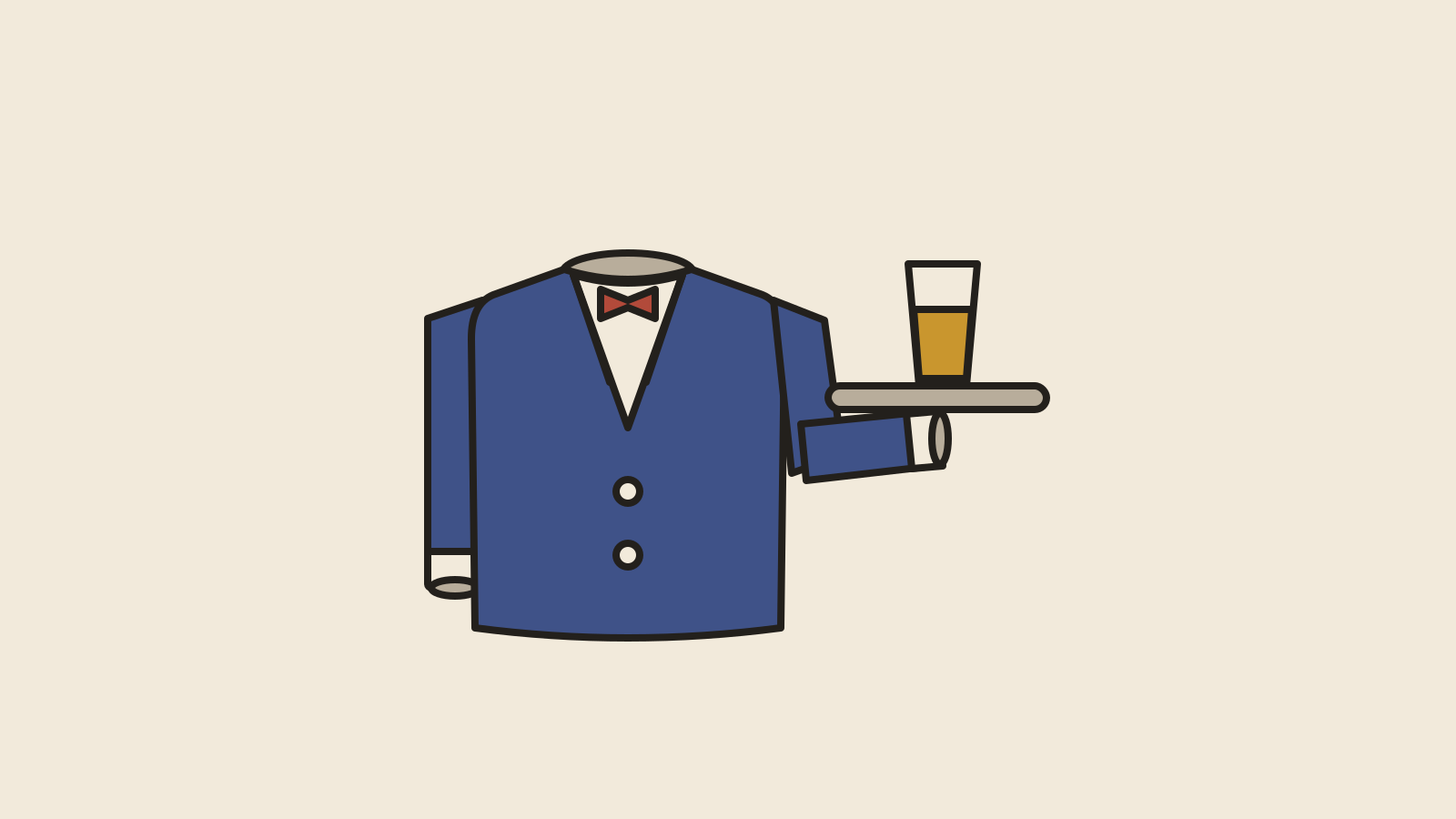
His example is a café waiter whose gestures are a little too crisp and too eager, because he is playing at being a waiter, as though the job fixed what he is in the way a glass is a glass. The opposite dodge is just as common. Someone who says "that isn't the real me" about a habit of twenty years is pretending to be pure possibility with no record. In both cases the person half knows better, which is why Sartre calls it bad faith and not a mistake.
Diagram
Bad faith hides in one side of a person and denies the other
Read as text
Two columns under the heading what a person is. On the left is facticity: my past, my body and my situation. On the right is transcendence: my freedom, my possibilities and my next choice. A person is always both. Bad faith hides in one column and denies the other, as when a waiter claims to be nothing but a waiter or a habitual liar claims his record does not count.
Key features
- It is a lie told to oneself, so deceiver and deceived are one person and what is hidden never drops fully out of view.
- It works by overplaying facticity, the given facts of a life, or by overplaying transcendence, the power to go beyond them.
- Its motive is anguish: owning one's freedom means owning what one has made of it.
- Sincerity is no cure, since declaring "I am just a coward" treats oneself as a fixed thing again.
- Sartre names the way out authenticity and says very little about it.
Not to be confused with
| Look-alike | The difference | Differs on |
|---|---|---|
| Existence precedes essence | The formula is Sartre's general claim that people have no fixed nature and make themselves. Bad faith is the everyday conduct of people who would prefer the claim to be false. | Differs onScope |
| Defence mechanisms | Freud's defences run unconsciously, so the person can't see them at work. Sartre denied any such hidden agency. In bad faith a single consciousness knows what it is avoiding, and so answers for it. | Differs onMechanism |
| Cognitive dissonance | Dissonance theory is tested psychology. It predicts when people adjust beliefs to ease discomfort, and it blames nobody. Bad faith is a moral description of a failure to own one's freedom. | Differs onDescriptive or normative |
| Dramaturgy | Goffman quotes Sartre's waiter and draws a different lesson: performing a role for an audience is how social life normally works. Sartre finds fault only when the performer takes the role for his nature. | Differs onClaim |
- Differs onScope
The formula is Sartre's general claim that people have no fixed nature and make themselves. Bad faith is the everyday conduct of people who would prefer the claim to be false.
- Differs onMechanism
Freud's defences run unconsciously, so the person can't see them at work. Sartre denied any such hidden agency. In bad faith a single consciousness knows what it is avoiding, and so answers for it.
- Differs onDescriptive or normative
Dissonance theory is tested psychology. It predicts when people adjust beliefs to ease discomfort, and it blames nobody. Bad faith is a moral description of a failure to own one's freedom.
- Differs onClaim
Goffman quotes Sartre's waiter and draws a different lesson: performing a role for an audience is how social life normally works. Sartre finds fault only when the performer takes the role for his nature.
Origins and development
Sartre set out the idea in Being and Nothingness (1943), in an early chapter on which the rest of the book depends. The French phrase, mauvaise foi, is the ordinary term for dishonest dealing, and he turned it inward. Part of his aim was to replace Freud's unconscious with something a person could be held to account for. He applied the idea to prejudice in Anti-Semite and Jew (1946). Simone de Beauvoir used it in The Second Sex (1949) and added a limit: people denied real options are oppressed, and the charge doesn't apply to them.
The unconscious
Freud's claim that wishes, fears and memories kept out of awareness go on steering what people think, feel and do.
Simone de Beauvoir
The French existentialist philosopher and novelist whose book The Second Sex argued that womanhood is made by society more than given by biology.
Why it matters
The phrases are everywhere once you listen for them: "I had no choice", "I'm only doing my job", "that's just how I am". Existential therapists treat such sentences as places where a client has handed a decision over to circumstance, and courses in professional ethics use the idea for the official who hides behind a role. It also explains why an excuse can annoy us even when every fact in it is true.
Critiques and limits
Sartre himself raised the first objection, that one person cannot both know something and hide it from himself. Many doubt that his answer, a belief held on deliberately thin evidence, removes the puzzle. Herbert Marcuse argued in 1948 that a freedom said to survive any condition makes even the persecuted answerable for their lot. Michèle Le Doeuff argued in 1989 that the examples lean on stereotype, above all those about women, whose minds Sartre claims to read better than they can. The idea is conceptual: it stands or falls by argument.
Herbert Marcuse
The German-American philosopher who argued that affluent societies control people by satisfying them, and who became the theorist of the 1960s New Left.
Connections
Belongs to
It is the movement's account of inauthentic living, the ways people disown a freedom they cannot lose.
Originated by
Sartre defined it in Being and Nothingness in 1943, with the café waiter and the champion of sincerity as examples.
Influenced by
It reworks Heidegger's inauthenticity, in which people do what one does and let the crowd choose for them.
Critiques
The unconsciousPsychology
Sartre offered bad faith in place of Freud's unconscious, arguing that a censor must know what it hides.
Contrasts with
Differs on scope. The formula is the general claim that people make themselves, and bad faith is the everyday flight from that claim.
Defence mechanismsPsychology
Differs on mechanism. Freud's defences run unconsciously, where bad faith is the work of one consciousness that knows what it is avoiding.
Cognitive dissonancePsychology
Differs on descriptive or normative. Dissonance theory predicts belief change and blames nobody, where bad faith is a moral description of disowned freedom.
DramaturgySociology
Differs on claim. Goffman treats playing a role as normal social life, where Sartre faults the performer who takes the role for his nature.
Further reading
- Bakewell, S. (2016). At the existentialist café: Freedom, being, and apricot cocktails. Chatto & Windus.
- Flynn, T. R. (2006). Existentialism: A very short introduction. Oxford University Press. https://doi.org/10.1093/actrade/9780192804280.001.0001
- Sartre, J.-P. (1956). Being and nothingness: An essay on phenomenological ontology. Philosophical Library. (Original work published 1943)
Cite this entry
Scholia. (2026). Bad faith. In Scholia: Notes in the margin of the human sciences. Retrieved November 28, 2026, from https://scholia.zennia.sg/ideas/bad-faith